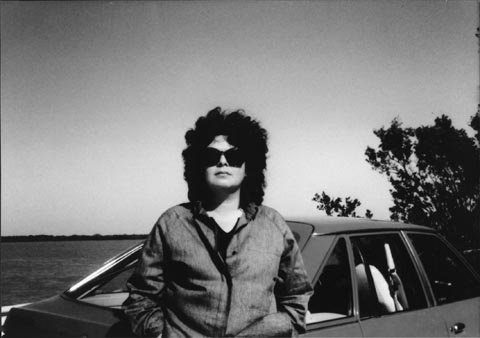
Michelle Cliff, the Jamaican-American novelist, essayist and editor whose books include No Telephone to Heaven and Free Enterprise, died on June 12, 2016.
Born Michelle Carla Cliff on November 2, 1946, in Kingston, Jamaica, she grew up in Jamaica and the United States after her parents emigrated to New York soon after her birth. She earned a bachelor’s degree in European history from Wagner College in 1969, worked as a researcher at Time-Life Books and as a production editor at W. W. Norton, and studied art at the Warburg Institute of the University of London, where she received a master of philosophy degree in 1974. She later taught at Trinity College in Hartford, Connecticut, where she was the Allan K. Smith Professor of English Language and Literature.
In 1975 Cliff met the poet Adrienne Rich, who was published by Norton, and the two became lifelong partners. Together they edited the journal Sinister Wisdom from 1981 to 1983.
Claiming an Identity They Taught Me to Despise (1980) is a 64-page book that blends poetry and prose, published by Persephone Press.
No Telephone to Heaven (1987) follows Clare Savage, the light-skinned Jamaican protagonist of Cliff’s first novel, Abeng, as she moves between Jamaica, England and the United States in search of a place and a self.
Free Enterprise (1993), subtitled A Novel of Mary Ellen Pleasant, is set in 1858 and tells of Pleasant, a San Francisco hotel owner whose hotels secretly shelter runaway slaves, and Annie, a young Jamaican woman, who join John Brown’s abolitionist enterprise.
If I Could Write This in Fire (2008) is her first book-length collection of nonfiction, interweaving essays and poems on her life in Jamaica, England and the United States with a critique of racism, homophobia and social injustice.
Everything Is Now (2009) gathers her short fiction in one volume, with stories that examine the dualities of the modern world, among them past and present, and colonialism and revolution.
The New York Times described her work as drawing on her multicultural identity to examine the psychic and historical damage done by colonialism and racism.
Complete Bibliography
Novels: Abeng (1984), No Telephone to Heaven (1987), Free Enterprise: A Novel of Mary Ellen Pleasant (1993), Into the Interior (2010)
Short stories: Bodies of Water (1990), The Store of a Million Items (1998), Everything Is Now: New and Collected Stories (2009)
Poetry: Claiming an Identity They Taught Me to Despise (1980), The Land of Look Behind: Prose and Poetry (1985)
Nonfiction: If I Could Write This in Fire (2008)
Edited: The Winner Names the Age: A Collection of Writings by Lillian Smith (1978)
Michelle Cliff died of liver failure on June 12, 2016, at her home in Santa Cruz, California. She was 69. Her longtime partner, Adrienne Rich, died in 2012.
Further Reading
Reference and critical works in the collection that discuss Cliff and her writing include Sandra Pollack and Denise D. Knight’s Contemporary Lesbian Writers of the United States, Carl Rollyson’s Novelists With Gay and Lesbian Themes, Laura Doan’s edited collection The Lesbian Postmodern, and Lisa Walker’s Looking Like What You Are.