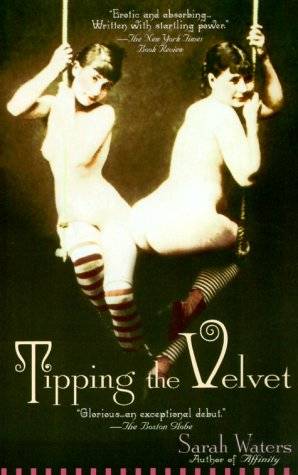
Let’s get the title out of the way, since it’s what everyone ends up searching for. “Tipping the velvet” is Victorian slang for oral sex between women. Sarah Waters put it on the cover of her first novel in 1998, and it has been making library patrons blush ever since.
Here’s the setup. Nancy Astley is an oyster girl in Whitstable, Kent. She works in her family’s oyster parlour and spends her evenings at the local music hall. One night she watches Kitty Butler, a male impersonator in a top hat and tails, and that’s it for Nan. She follows Kitty to London, ends up on stage beside her, and becomes “Nan King,” half of a cross-dressing double act.
That’s roughly the first third. The /books entry says her life “takes a dramatic turn,” and that phrase is doing a lot of heavy lifting.
Waters wrote a PhD on lesbian and gay historical fiction before she wrote this book, and it shows. Tipping the Velvet borrows the shape of the big Victorian novel: an innocent leaves home, has her heart broken, falls through every layer of London society and comes out the other side. Think Dickens, if Dickens had been allowed to write about what Nan gets up to in trousers.
Without spoilers, the novel moves through three worlds. First come the music halls, with their greasepaint and gaslight. Then there’s a wealthy, decadent household where Nan is kept, and not in the cozy sense. Last come the working-class streets and socialist meetings of East London. Each section almost reads like a different book, and the shifts are the point. Nan keeps reinventing herself, and Waters keeps asking which version is the real one.
In 1998, an explicit lesbian historical novel from a mainstream publisher that critics took seriously was rare. The /books entry quotes praise from The New York Times Book Review, the Boston Globe, the San Francisco Chronicle and a starred Kirkus review. That’s unusual company for a story about an oyster girl who falls for a woman in a top hat.
In 2002 the BBC adapted it as a three-part series written by Andrew Davies, with Rachael Stirling as Nan and Keeley Hawes as Kitty. Davies also wrote the 1995 Pride and Prejudice, the Colin Firth one, which tells you how seriously British television took the book. Or how much fun Davies was having.
Waters followed it with Affinity (1999) and Fingersmith (2002), which readers call her Victorian trilogy. Fingersmith later became Park Chan-wook’s film The Handmaiden. If you’re reading them in order, Affinity swaps the music hall for Millbank prison and a spiritualist medium, and it has its own entry in the bibliography.
This is for readers who want the full Victorian experience, 480 pages in the Riverhead paperback, with lesbian desire at the center instead of buried in subtext. Nan narrates in first person with a lot more swagger than Pip, so even people who skipped every Dickens assignment in school have a way in.
A few questions for the comments. Nan performs as a man on stage and later on the street. Is her story mostly about gender, sexuality or money? Did you watch the BBC series, and if so, book first or show first? And Tipping the Velvet or Fingersmith: which do you hand to a reader new to Waters?
Edition details and the full critics’ quotes are on the Tipping the Velvet entry in the Lesbian Bibliography.