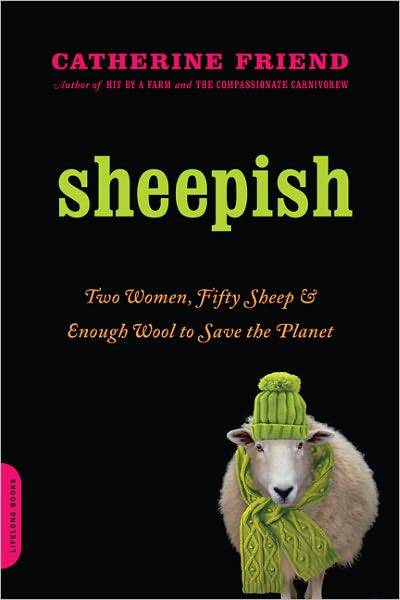
“What do you do when you love your farm… but it doesn’t love you?”
That’s the question Catherine Friend asks at the start of Sheepish, and anyone who has ever loved a house, a job or a relationship that kept breaking their heart will recognize it. Swap “farm” for almost anything and it still works. That’s part of why a memoir about raising sheep in Minnesota has more reach than you might expect.
The full subtitle is Two Women, Fifty Sheep, and Enough Wool to Save the Planet, and the two women are Friend and her partner, Melissa. Da Capo published the book in 2011, about fifteen years into their life as shepherds. If you’ve read Friend’s earlier memoir, Hit by a Farm, you already know the setup: a city-raised writer follows her partner into rural life and finds herself knee-deep in mud, manure and livestock with opinions.
By the time of Sheepish, the novelty has long worn off. Friend is tired. Shepherding is getting harder, and she’s seriously considering giving it up. The /books entry notes that the number of sheep in America has fallen sharply over the past several decades, which tells you something about how tough the economics are. Small farms are hard. Small sheep farms are harder.
Then comes the turn. Just as she’s ready to walk away, Friend starts to realize that sheep, and the small farms that raise them, might be too valuable to give up on. That’s where the “save the planet” part of the subtitle comes in. The book makes a case for wool, for local agriculture, and for the kind of slow, hands-on farming that is quietly disappearing.
What makes it a fun read, rather than a lecture, is Friend’s voice. She’s funny about her own failings and about the absurdity of farm life. Sheep do not cooperate. Weather does not cooperate. Your own body, after fifteen years of hauling hay, definitely does not cooperate. The book’s charm is in watching her complain about all of it while clearly loving it anyway.
There’s a quiet lesbian story underneath as well. This is a portrait of a long-term relationship between two women working side by side, disagreeing about the farm and figuring out how to keep going together. It isn’t a romance, and the book isn’t really about being gay, but that’s part of its appeal. Two women running a farm in rural Minnesota is simply presented as normal life, because it is.
This is for readers who dream about a hobby farm and would like a reality check first. It’s also for knitters and fibre artists who want to know where their wool comes from, fans of funny memoirs, and anyone at a crossroads with something they love but aren’t sure they can keep doing.
Tell me in the comments: have you ever loved something that didn’t love you back? Would you ever trade city life for a farm, or is that strictly a fantasy? And knitters, how much do you think about where your yarn comes from?
Publication details are on the Sheepish entry in the Lesbian Bibliography.