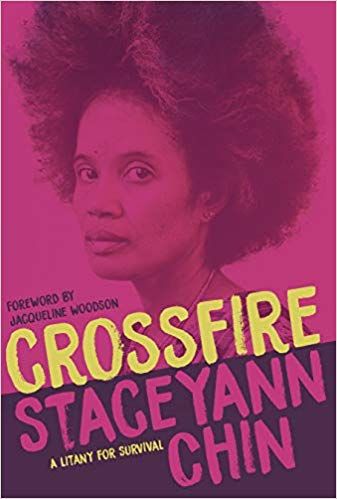
The subtitle is the first clue. Crossfire: A Litany for Survival borrows its second half from Audre Lorde, whose poem “A Litany for Survival” has been a touchstone for Black lesbian writers since the 1970s. Putting that phrase on your cover is a statement of lineage. Staceyann Chin is telling you exactly whose tradition she’s writing in.
It’s a fair claim. Chin, a Jamaican-born poet and spoken word artist, has spent more than two decades writing and performing feminist, lesbian, Caribbean and activist poetry. She came to wider attention in the early 2000s through Def Poetry Jam, including its run on Broadway. She later wrote a memoir about growing up in Jamaica, The Other Side of Paradise. Her stage persona is large, loud and funny, and The New York Times once described her as “sassy, rageful and sometimes softly self-mocking.”
That’s a hard combination to get onto the page. Spoken word lives in the room: the timing, the volume, the audience shouting back. Plenty of performance poets lose something when their work is printed. Crossfire is Chin’s answer to that problem, and it’s a confident one.
Haymarket Books published it in 2019 as her first full-length collection. She chose the poems herself, and they span 1998 to 2019, so you’re reading two decades of a working poet’s life in one place. That range is the book’s great strength. You can watch her move from the young poet arriving in New York to the activist, the mother and the veteran performer. The early anger doesn’t disappear, but it changes shape.
The Advocate noted that her poems pair funny one-liners with a refusal to conform, and that she’s out to challenge more than just the straight world. That’s worth underlining. Chin has never been interested in being a polite lesbian poet. She takes on homophobia, but also racism, colonialism, misogyny and the comfortable parts of queer culture that would rather not hear about any of them.
The book won an American Book Award, and the bibliography rates it Great, its highest rating. For a collection of poems first written for the stage, that’s quite a vote of confidence from the page side of the house.
This is for readers who love Lorde and want to see who carried the work forward. It’s also for spoken word fans who have only ever heard Chin and want to sit with the words, and for anyone who likes poetry with some fire in it. If you have a younger queer person in your life who thinks poetry is boring, hand them this one.
So, a few things to argue about. Does spoken word poetry belong on the page, or does it lose too much? Which poets do you think of as Lorde’s heirs? And if you’ve seen Chin perform, did reading her change how you hear her?
Publication details and the award listing are on the Crossfire entry in the Lesbian Bibliography.