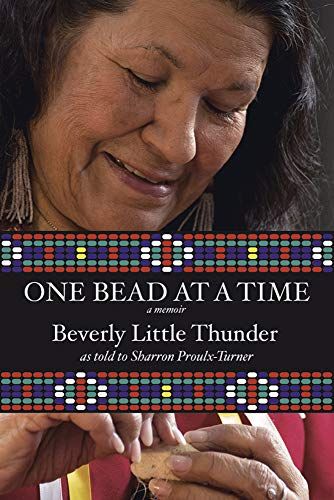
Early in her adult life, Beverly Little Thunder had a dream. In it she was offered a choice of ponds and picked one with lots of lily pads and no frogs, because she wanted to build a community. According to the /books entry, that’s exactly what she went on to do for the rest of her life.
One Bead at a Time is the story of that life, and it’s told in an unusual way. It’s an oral memoir. Little Thunder, a Two-Spirit Lakota Elder from Standing Rock, told her story aloud. Sharron Proulx-Turner, a Two-Spirit Métis writer, transcribed and edited it, keeping the words as close to verbatim as possible. The point was to let Little Thunder’s own voice and sense of humour come through on the page, instead of smoothing her into a ghostwriter’s prose.
That choice makes a real difference. Oral storytelling has its own rhythm. It circles back, it digresses, it stops for a joke, and it trusts the listener to keep up. Reading an oral memoir is closer to sitting across a kitchen table from someone than to reading a polished book. For a story rooted in Indigenous tradition, that form feels right. Inanna Publications published it in 2016.
Little Thunder has spent most of her life serving Indigenous and non-Indigenous women across the United States and Canada. She was active in the American Indian Movement. Most remarkably, she established what the /books entry describes as the first and only all-women’s Sundance in the world, held on land in the Green Mountains of Vermont set aside for future generations of Indigenous women’s ceremony.
The Sundance is one of the most important ceremonies in many Plains nations. Little Thunder has spoken publicly about being excluded from ceremony after coming out as a lesbian. Founding a women’s Sundance was her answer: if there was no place for her, she would make one, and make it for other women too. It’s the lily pad dream made real.
The bibliography rates the book Good, and it describes her as a remarkable visionary. That’s not an exaggeration. Plenty of activists change a policy or win a court case. Far fewer create a ceremony that will outlive them.
This is for readers interested in Indigenous women’s history and Two-Spirit lives, and for anyone curious about how spiritual traditions change when the people inside them insist on being included. It’s also for readers who enjoy memoirs that sound like a real person talking, digressions and all.
For a companion read, A Generous Spirit, the selected works of Mohawk writer Beth Brant, is also published by Inanna and also in the bibliography. Between the two, you get two very different Two-Spirit voices, one writing and one speaking.
Tell me in the comments. Have you read oral memoirs or oral histories before, and do you like the form? What would your own lily pad pond look like, the community you’d build if you could? And who are the elders who made room for you?
Full details are on the One Bead at a Time entry in the Lesbian Bibliography.