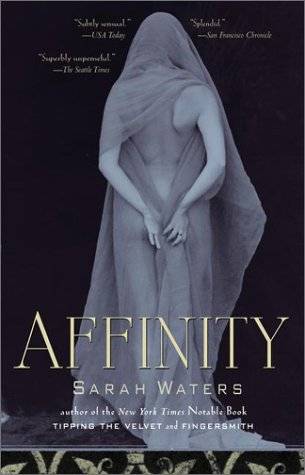
If Tipping the Velvet is Sarah Waters throwing a party, Affinity is Sarah Waters turning off the lights and telling a ghost story.
The /books entry, quoting a review by Kerry Fried, makes the comparison directly. Waters’s debut was a lesbian romp with a utopian socialist streak. Her second novel, first published in 1999, is just as sensual but far darker, and its moral is much harder to pin down. If you came to Waters for Nan King’s swagger, be prepared. This is a very different mood.
The year is 1874, and the setting is Millbank, a vast, grim prison on the Thames in London. Margaret Prior is nearly thirty, plain by the standards of her time, unmarried, and recently recovered from an illness that was probably more than physical. To give herself a purpose, she becomes a Lady Visitor, one of the respectable women who visited female prisoners to offer moral comfort.
In one of the cells she meets Selina Dawes. Selina is a spiritualist medium, the kind of woman who held séances in Victorian parlours. She’s been convicted of fraud and assault after a sitting went badly wrong. She’s striking, strange and unsettling, and Margaret can’t stop thinking about her.
Then things start to happen. A locket goes missing. Flowers appear. Margaret begins to feel she has a companion who knows everything about her. And Selina seems to love her.
The book alternates between two voices: Margaret’s journal, full of her loneliness and her memories of a first love who is now married to her brother, and Selina’s sparer account of her life before prison. The review on /books points out that this structure first makes you think you can sort truth from desire. By the end, Waters has shown that knowing something and believing something are very different things. That’s all that can be said without spoilers. The ending has a reputation, and it deserves it.
For anyone who loves noir or gothic fiction, Affinity is a gift. It has a claustrophobic setting, a narrator you’re not sure you can trust, a mysterious woman, and a growing sense that someone is being played. Swap the gaslight for neon and it wouldn’t be far from a classic noir plot. The Victorian craze for spiritualism also makes a perfect backdrop, a whole society that wanted badly to believe.
It was a Lambda Literary Award finalist, and the bibliography rates it Good. In 2008 it was adapted as a British television film, though the novel’s double narration is hard to put on screen, and readers tend to prefer the book.
This is for Waters fans who want to read the Victorian trilogy in order, and for gothic and ghost story lovers. It’s also for noir readers who like the mysterious woman with an agenda, and for anyone who enjoys a novel that makes them want to go back to page one as soon as they finish.
Over to you. Tipping the Velvet or Affinity: which Waters mood do you prefer? Do you believe in ghosts, or just in people who say they’ve seen them? And which book has an ending that made you flip straight back to the beginning?
Full details are on the Affinity entry in the Lesbian Bibliography, and the debut has its own entry.