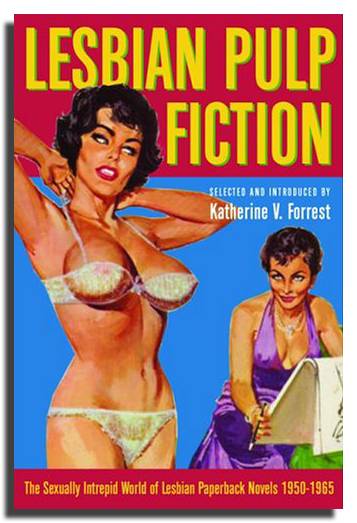
Picture a spinning wire rack in a 1950s drugstore. Among the westerns and the hard-boiled detective novels are paperbacks with titles like Women’s Barracks, Odd Girl Out and Spring Fire. The covers show two women in slips, one leaning toward the other with a meaningful look. The cover lines promise something shocking about “a love the world forbids.” They cost a quarter.
Those were the lesbian pulps, and for a lot of women in the 1950s and early 60s, they were the only books in the world that admitted women like them existed.
Lesbian Pulp Fiction: The Sexually Intrepid World of Lesbian Paperback Novels 1950-1965, published by Cleis Press in 2005, is Katherine V. Forrest’s tour of that world. Fawcett’s Gold Medal imprint started the genre in 1950. The books were cheap and sold everywhere. They were meant for male readers looking for a thrill, but women found them too. As the /books entry puts it, readers living ordinary lives found proof in them that they weren’t alone, along with a glimpse of places like Greenwich Village where women like them gathered.
The books varied wildly. Some, especially those written by lesbians, were sympathetic and surprisingly realistic portraits of “life in the shadows.” Others were sensational melodramas about innocent girls led astray. Many ended unhappily, partly to satisfy censors. Forrest’s anthology collects excerpts and traces how a whole lesbian subculture took shape on those cheap pages.
Forrest is the right guide. She’s one of the most important lesbian writers of the late twentieth century. Her novel Curious Wine is a lesbian classic, and her Kate Delafield mysteries, about a lesbian detective in the Los Angeles police department, helped create lesbian crime fiction as a genre. She has also written about finding a lesbian pulp in a drugstore as a young woman and what it meant to her. So this is partly a personal book. She’s going back to the shelf that changed her life.
For noir readers, the pulps are especially interesting. They were sold on the same racks as the hard-boiled crime novels, often by the same publishers, with the same cover artists and the same lurid style. The two genres grew up side by side, and you can feel it. Smoky bars, dangerous women and secrets that could ruin you are all here. Lesbian noir has deep roots, and many of them are in these paperbacks.
This is for readers who love vintage paperbacks and the cover art that sold them. It’s also for writers of lesbian crime and noir who want to see where the genre’s DNA comes from, for anyone interested in lesbian life before Stonewall, and for collectors who want a guided tour before they start hunting second-hand shops. At 440 pages, it’s a lot of pulp for the money.
For the history that surrounds those books, Lillian Faderman’s Odd Girls and Twilight Lovers is also in the bibliography, and its title is a nod to the pulps.
In the comments, tell me about the pulps. Have you ever found one in a used bookstore? Do you have a favourite cover? And do the pulps’ unhappy endings make them hard to love, or are they important anyway?
Full details are on the Lesbian Pulp Fiction entry in the Lesbian Bibliography.