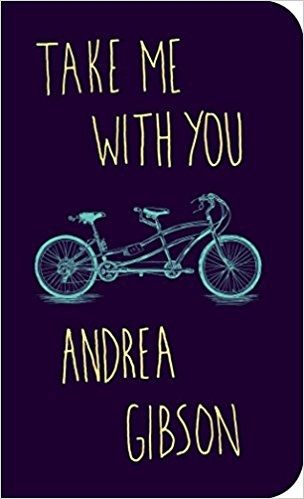
Some poetry books are meant for a desk, a pencil and a quiet afternoon. Andrea Gibson’s Take Me With You is meant for a coat pocket. The /books entry notes that it’s small enough to carry around, and that’s the whole idea. This is a book designed to come along with you and be opened on a bus, in a waiting room, or on a bad day when you need one good line.
Plume published it in 2018. Its 208 pages are full of line drawings by Sarah J. Coleman, and the poems range from single lines and couplets to longer pieces. The book is divided into three parts: On Love, On the World and On Becoming. That’s a pretty good summary of Gibson’s career in six words.
For anyone who doesn’t know the name, Gibson was one of the best-known spoken word poets in the United States. They were a fixture of slam poetry and queer stages for two decades, and their performances were shared millions of times online. They wrote about love between women, gender, politics, family, illness and forgiveness. They used they/them pronouns long before most people knew what that meant. In 2023 they were named Colorado’s poet laureate. Gibson died in July 2025, after years of writing and speaking publicly about living with cancer.
That gives Take Me With You a different weight now than it had when it was published. The book opens with a wish to leave this life with a heart broken wide open, in many pieces. In 2018 that read as a declaration of how to live. Today it also reads as a farewell that came early.
The short format suits Gibson well. Spoken word poets learn to land a line in front of a crowd that may not be listening yet, and many of the one-liners here have that quality. You can read one, close the book, and carry it around for the rest of the day. The longer poems give you the fuller Gibson, the one who could hold a room for ten minutes and make it cry and laugh in the same breath.
The publisher pitched the book to readers of Rupi Kaur and Cheryl Strayed. That comparison makes sense for the format, but Gibson’s politics are sharper and their queerness is central. Love here is mostly love between women and gender-nonconforming people. On the World is angry in places. On Becoming is about growing into a self that doesn’t fit the categories you were handed.
This is for readers who think they don’t like poetry, people who need a gift for a newly out friend, and longtime Gibson fans who want something lighter than a full collection to keep close.
A question or two for the comments. Did you ever see Gibson perform, live or online? Which do you prefer, poems you read silently or poems you hear aloud? And if you could only carry one line of poetry around for the rest of your life, what would it be?
Full details are on the Take Me With You entry in the Lesbian Bibliography.