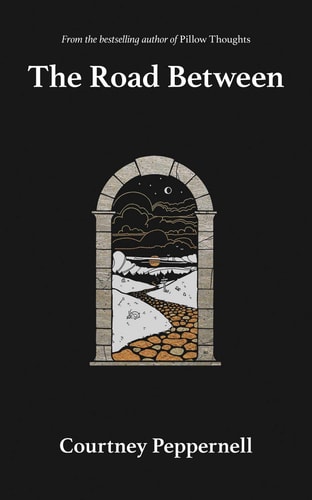
Few genres get people as worked up as instapoetry. You know the style: short lines, lots of white space, sentiments about healing and heartbreak, the kind of poem that fits neatly on a phone screen and gets shared thousands of times. Some readers love it because it’s accessible. Some critics hate it for the same reason.
Courtney Peppernell is one of the names at the center of that debate. The Australian poet built a huge readership with Pillow Thoughts, first self-published and then picked up by Andrews McMeel, the same publisher behind Rupi Kaur’s milk and honey. The Road Between, published in 2017, is her follow-up, a 304-page collection of poetry and prose.
What makes Peppernell matter to this site is that her work is openly queer. Much of the love in her poems is love between women. For a lot of young readers, especially those who would never have walked into the poetry section of a bookstore, her books were the first time they saw that experience reflected in verse. That’s not a small thing.
The publisher frames The Road Between as a journey from shadow toward light. It’s for readers who go back and forth between losing themselves in the world and finding themselves again, often in small moments. The book invites readers to look inward, to heal, and to find the strength to come home. If you read that and rolled your eyes, you probably already know which side of the instapoetry debate you’re on. If you read it and felt something, the same is true.
The case against the genre is familiar. Critics say the poems are too simple, too much like greeting cards, too easy to imitate. They say the line breaks are doing work the language should be doing. The case for it is just as familiar. Poetry was once a popular art, and instapoets have brought millions of new readers to it. Many of those readers are young women and queer kids, and they don’t care what the critics think.
Both arguments have some truth in them. A book like The Road Between isn’t trying to be Elizabeth Bishop. It’s trying to sit beside someone at two in the morning and tell them it gets better. Whether that counts as poetry depends on what you think poetry is for.
This is for readers who loved Pillow Thoughts, younger queer women looking for something comforting, and anyone who wants to make up their own mind about instapoetry instead of taking the critics’ word for it. It might also suit a reader who’s grieving and can’t manage long paragraphs right now. Short pieces you can read one at a time have real value.
The comments are open. Is instapoetry real poetry? Did a poem you first saw on social media ever stick with you? And is accessibility a weakness in art, or the whole point?
Details are on The Road Between entry in the Lesbian Bibliography.