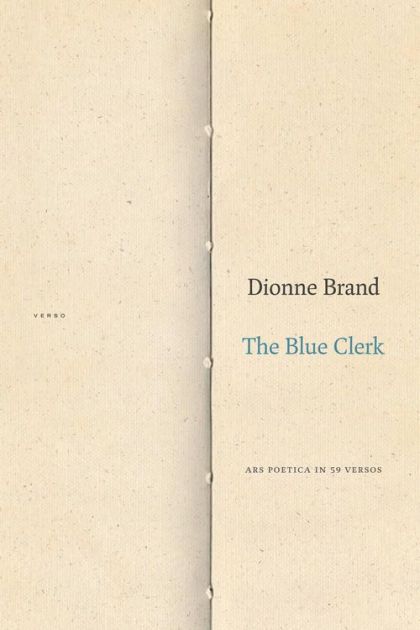
Picture a lonely wharf. On it stands a clerk in an ink-blue coat, going through bales of paper. Every bale holds the writing a poet never finished, never published, or never dared to put down. Dionne Brand’s book calls it “the unwritten, the withheld, the unexpressed.”
That’s the setup of The Blue Clerk, and it’s one of the most memorable images in recent Canadian poetry. The book is a long conversation, sometimes an argument, between a poet and the clerk who keeps the leftover pages. Brand subtitles it ars poetica in 59 versos. An ars poetica is a poem about the art of poetry itself, and a verso is the left-hand page of a book. So the title tells you this is a book about writing, built from the pages we usually don’t see.
Brand is one of the most important writers in Canada. She was born in Trinidad, came to Toronto as a young woman, and has spent decades writing poetry, fiction and essays about Black life, diaspora, desire and the city. She served as Toronto’s poet laureate from 2009 to 2012, and she is a lesbian writer whose work has never treated that as a side note. The Blue Clerk won the 2019 Griffin Poetry Prize, one of the biggest poetry awards in the world. Duke University Press published the edition listed in the bibliography in 2018.
The book is written as prose poems, which means it looks more like paragraphs than lines. That makes it more approachable than some experimental poetry. You can read a verso like a short essay. But each one keeps turning, and the voices of the poet and the clerk keep interrupting each other.
Along the way, Brand calls in a crowd of artists and thinkers. The /books entry names the painter Jacob Lawrence, the jazz musician John Coltrane, the philosopher Walter Benjamin, the writer Jorge Luis Borges, the artist Josephine Turalba, and Lola Kiepja, remembered as the last of the Selk’nam people of Tierra del Fuego. It’s quite a dinner party. Through them, the book thinks about memory, language, culture and time, and about how hard it is to write anything honest in the world as it is.
That makes The Blue Clerk a book about writing that’s also a book about the present. The withheld pages aren’t only private. They include everything a Black woman writer has had to hold back, edit out or keep to herself just to get through.
This is for poets and writers, obviously, but also for readers who like essays and want something that stretches them. Toronto readers will find it rewarding as well, since Brand is one of the city’s great literary voices. If you’ve never read her, it’s an ambitious place to start. If you have, it may feel like a summing up.
Some questions for the comments. What would be in your own bales on the wharf? Do you think writers owe us everything, or is withholding part of the art? And who’s the Canadian writer you think everyone should read before they read anyone else?
Full details are on The Blue Clerk entry in the Lesbian Bibliography.