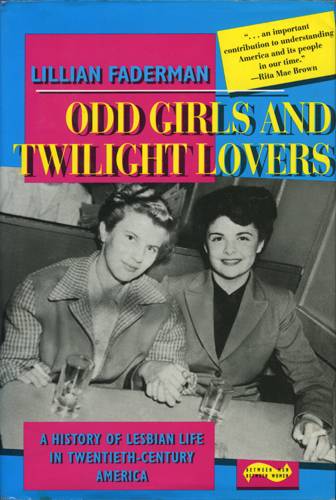
Here’s a question that sounds simple: when did lesbians begin?
Not when did women start loving women. That’s always happened. The question is when people started thinking of it as an identity, a type of person with a name, and how that idea changed over the following decades. That’s the question at the centre of Lillian Faderman’s Odd Girls and Twilight Lovers, published by Columbia University Press in 1991. More than thirty years later, it’s still one of the essential books on the subject.
Faderman’s argument is that the “lesbian” as we understand her is largely a twentieth-century invention. In the nineteenth century, intense love between women was often called romantic friendship and seen as sweet, even admirable. Then several things changed at once. Women got access to higher education, campaigned for equal rights and entered the workforce. For the first time, many of them could support themselves without a husband. At the same time, sexologists began labelling love between women as a disorder. Romantic friendship became something suspicious, and a new identity, with all its dangers and possibilities, was born.
From there, the book moves decade by decade. It begins with the women’s colleges and the sexologists of the 1920s and moves through wartime, when women in uniform and factory jobs found each other in large numbers. Then come the McCarthy era, when lesbians were hunted as security risks, and the radical movements of the 1960s and 70s. The book ends with the more diverse lesbian communities of the 1980s.
A review quoted on the /books entry praises the range of sources. Faderman draws on literature, sociological and psychological studies, newspapers, military pamphlets and films. That variety is what makes the book so readable. You aren’t just reading arguments. You’re reading what people actually said and wrote at the time.
The same review notes a fair criticism. Big generalizations can flatten individual lives. Faderman is telling the story of large shifts, and plenty of women didn’t fit them. But the book’s great strength is how it treats lesbianism both as a sexual orientation and as something shaped by economics, politics and culture. Who could be a lesbian, and what it meant, depended on far more than desire.
The title is a nod to the lesbian pulp paperbacks, whose titles loved words like “odd” and “twilight.” For a closer look at those books, Katherine V. Forrest’s Lesbian Pulp Fiction is also in the bibliography. Faderman’s history and Forrest’s anthology make an excellent pair, one giving you the big picture and the other the books women were actually reading.
Faderman also wrote Surpassing the Love of Men, about romantic friendship in earlier centuries, and later The Gay Revolution, which carries the story forward. Odd Girls sits in the middle and is probably the best place to start.
This is for anyone who wants to understand lesbian history in one book, for readers of the pulps who want context, and for younger lesbians curious about how earlier generations lived. It’s also a good fit for anyone who reads Sarton, Highsmith or Stein and wants to know the world those women came out of.
Tell me in the comments. Which decade would you least like to have been a lesbian in, and which one most? Do you think of lesbian identity as something discovered or something invented? And what’s the one history book you’d make every queer person read?
Full details are on the Odd Girls and Twilight Lovers entry in the Lesbian Bibliography.