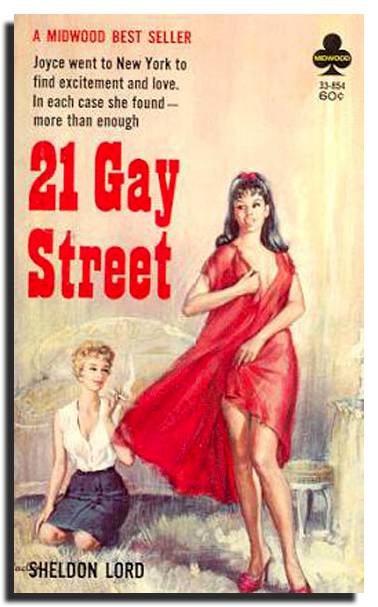
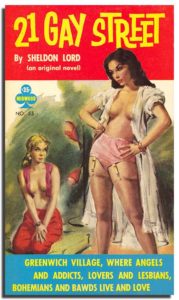
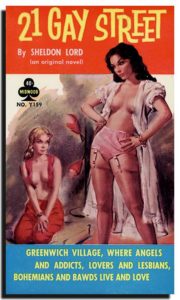
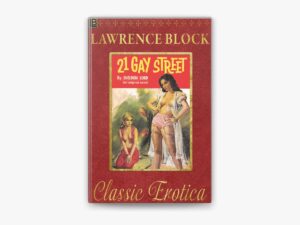
In 21 Gay Street, Sheldon Lord (a pseudonym for mystery legend Lawrence Block) provides a voyeuristic, “beatnik” look at Greenwich Village life in the late 1950s. The story follows Joyce Kendall, a fresh-faced college graduate from Iowa who arrives in New York for a job at a “true confessions” magazine. She finds a room in a Federal-period house on Gay Street, shared with a diverse cast: a struggling newspaperman and a cohabitating lesbian couple, Jean and Terri. As Joyce is initiated into the bohemian lifestyle of jazz clubs, drug-fueled parties, and shifting moral boundaries, the novel serves as both a “coming-to-the-city” tale and a classic piece of mid-century sleaze. While it leans into the sensationalism of the era—including an infamous “reefer madness” subplot—it captures a specific, grimy atmosphere of the pre-Stonewall Village.
Subject: Beat generation — New York (State) — New York — Fiction; Beat generation in literature; Greenwich Village (New York, N.Y.); Lesbians; Lesbians — Identity — Fiction; Lesbians — New York (State) — New York — Fiction
Comments
This book is a prime example of “Lesbian Pulp Fiction,” a genre that the New York Public Library and queer historians often categorize as Survival Literature. During the 1950s and 60s, these cheap mass-market paperbacks were often the only place where lesbian lives were visible in popular culture. Although written by a man and designed to be provocative, 21 Gay Street is significant for its depiction of a functional lesbian couple living openly (within their bohemian circle) at a time when such lives were largely underground. It remains a valuable historical artifact for its portrayal of Greenwich Village as a sanctuary for queer identity, helping to document the “New York City transplant” narrative that became a rite of passage for many queer women.