

Originally published in 1950, this account of life among female Free French soldiers in a London barracks during World War II sold four million copies in the United States alone and many more millions worldwide.
The novel is based on the real-life experiences of the author, Tereska Torres, who escaped from occupied France. She arrived as a refugee in London and joined other exiles enlisting in Charles de Gaulle’s army, then stationed in Britain awaiting an invasion of their homeland by Allied forces. But Women’s Barracks is no ordinary war story. The grim world of an urban military barracks became the setting for one of the steamiest novels of its time. Leaving ‘normal’ civilian life behind, the women enter an all-female realm, where passionate attachments soon form-between older, experienced women and young innocents, between butch officer types and their femmes subordinates. And for those with more traditional leanings, there was a city full of soldiers to be had- sometimes two or three at a time.
As the Blitz rains down over London, taboos are broken, affairs start and stop and hearts are won and lost. Torres dutifully relates the erotic adventures of her comrades with an equal sympathy toward straight and gay relationships that was unusual for its time.
Despite a tone that is frank rather than lurid, Women’s Barracks was banned for obscenity in several states. It was also denounced by the House Select Committee on Current Pornographic Materials in 1952 as an example of how the paperback industry was ‘promoting moral degeneracy.’ But in spite of such efforts-or perhaps, in part, because of them-the novel became a record-breaking bestseller and inspired a whole new genre: lesbian pulp.
Genre: Pulp
Subjects: Erotic Fiction; France; French combattante; Lesbian Sleaze; Lesbians - Fiction; London (England); Women Soldiers; World War II
Publication History
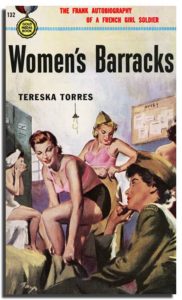
| Copyright Date | 1950 |
|---|---|
| Publication Date | 1950 |
| Publisher | Gold Medal |
| Format | Mass Market Paperback |
| No. of Pages | 189 |
| Language | English |
| Notes | Gold Metal 132 A*** rating in Grier Womens Barracks was banned for obscenity, and denounced by the House Select Committee on Current Pornographic Materials in 1952 as an example of how the paperback industry was promoting moral degeneracy. |
| Rating | Great |
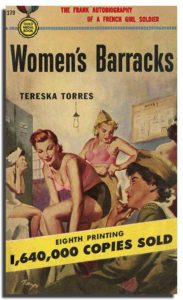
| Copyright Date | 1950 |
|---|---|
| Publication Date | February 1954 |
| Publisher | Gold Medal |
| Format | Mass Market Paperback |
| No. of Pages | 192 |
| Language | English |
| Notes | Gold Metal 379 A*** rating in Grier |
| Rating | Great |
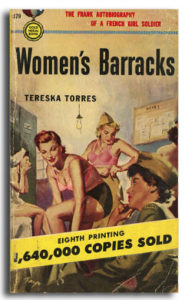
| Copyright Date | 1950 |
|---|---|
| Publication Date | March 1955 |
| Publisher | Gold Medal |
| Format | Mass Market Paperback |
| No. of Pages | 192 |
| Language | English |
| Notes | Gold Metal 379 A*** rating in Grier |
| Rating | Great |
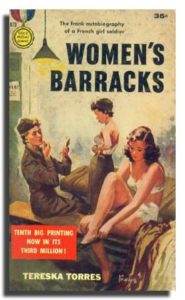
| Copyright Date | 1950 |
|---|---|
| Publication Date | 1957 |
| Publisher | Gold Medal |
| Format | Mass Market Paperback |
| Language | English |
| Notes | Gold Medal 673 A*** rating in Grier |
| Rating | Great |
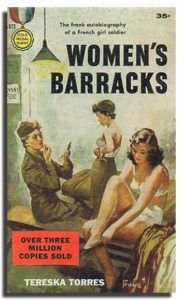
| Copyright Date | 1950 |
|---|---|
| Publication Date | 1957 |
| Publisher | Gold Medal |
| Format | Mass Market Paperback |
| Language | English |
| Notes | Gold Metal 673 A*** rating in Grier |
| Rating | Great |

| Copyright Date | 1950 |
|---|---|
| Publication Date | 1960 |
| Publisher | W. H. Allen |
| Format | Hardcover |
| No. of Pages | 216 |
| Language | English |
| Notes | A*** rating in Grier |
| Rating | Great |
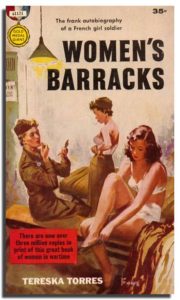
| Copyright Date | 1950 |
|---|---|
| Publication Date | 1961 |
| Publisher | Gold Medal Giant |
| Format | Mass Market Paperback |
| Language | English |
| Notes | Gold Metal s1171 A*** rating in Grier |
| Rating | Great |
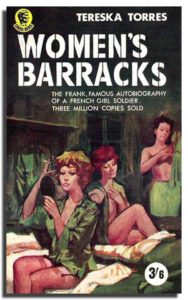
| Copyright Date | 1950 |
|---|---|
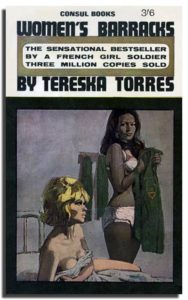
| Publication Date | 1962 |
| Publisher | Consul |
| Format | Mass Market Paperback |
| No. of Pages | 191 |
| Language | English |
| Notes | Consul Biography Paperback Book No 1116 |
| Rating | Great |
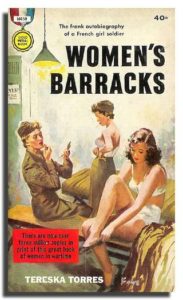
| Copyright Date | 1950 |
|---|---|
| Publication Date | 1964 |
| Publisher | Gold Medal |
| Format | Mass Market Paperback |
| No. of Pages | 189 |
| Language | English |
| Notes | Gold Metal k1450 A*** rating in Grier |
| Rating | Great |
| Copyright Date | 1950 |
|---|---|
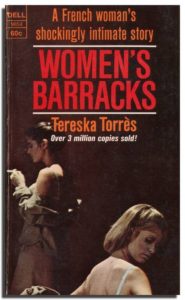
| Publication Date | 1964 |
| Publisher | Consul |
| Format | Mass Market Paperback |
| No. of Pages | 191 |
| Language | English |
| Notes | 'Originally published in 1950, this account of life among female Free French soldiers in a London barracks during World War II sold four million copies in the United States alone and many more millions worldwide. The novel is based on the real-life experiences of the author, Tereska Torres, who escaped from occupied France. She arrived as a refugee in London and joined other exiles enlisting in Charles de Gaulle’s army, then stationed in Britain awaiting an invasion of their homeland by Allied forces. But Women’s Barracks is no ordinary war story. As the Blitz rains down over London, taboos are broken, affairs start and stop and hearts are won and lost. Women’s Barracks was banned for obscenity in several states. It was also denounced by the House Select Committee on Current Pornographic Materials in 1952 as an example of how the paperback industry was “promoting moral degeneracy.” But in spite of such efforts - or perhaps, in part, because of them - the novel became a record-breaking bestseller and inspired a whole new genre: lesbian pulp...' |
| Rating | Great |
| Copyright Date | 1950 |
|---|---|
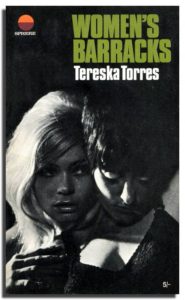
| Publication Date | 1968 |
| Publisher | Dell |
| Format | Mass Market Paperback |
| No. of Pages | 158 |
| Language | English |
| Notes | Dell 9654 A*** rating in Grier |
| Rating | Great |
| Copyright Date | 1950 |
|---|---|
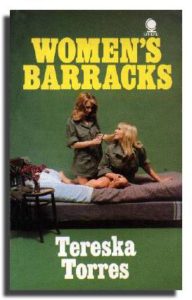
| Publication Date | 1968 |
| Publisher | Sphere |
| Format | Mass Market Paperback |
| No. of Pages | 192 |
| Language | English |
| Notes | Sphere Book 85499 |
| Rating | Great |
| Copyright Date | 1950 |
|---|---|
| Publication Date | 1972 |
| Publisher | Sphere |
| Format | Mass Market Paperback |
| No. of Pages | 192 |
| Language | English |
| Notes | price: 30p |
| Rating | Great |
| ISBN | 155861494X |
|---|---|
| Copyright Date | 1950 |
| Publication Date | May 1, 2005 |
| Publisher | Feminist Press at CUNY |
| Format | Trade Paperback |
| No. of Pages | 235 |
| Language | English |
| Notes | A*** rating in Grier |
| Rating | Great |
Comment
Women's Barracks holds a founding place in the history of lesbian publishing. Tereska Torrès based it on her own service with the Free French women's forces in wartime London, and her husband, the novelist Meyer Levin, translated it into English. Fawcett's Gold Medal imprint issued it in 1950 as a paperback original with a first printing of 200,000 copies, and historians credit it as the first American paperback original to become a bestseller. It sold more than two million copies in its first five years and some four million in the United States over its life, and it was translated into more than a dozen languages.
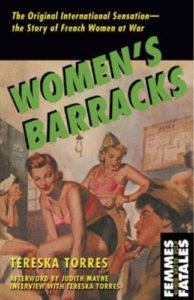
Its success shaped everything that followed. Gold Medal had marketed the book to men, but it found a large audience of women, and the publisher went looking for more novels on the theme, beginning with Vin Packer's Spring Fire in 1952. Literary historians date the golden age of lesbian pulp, the hundreds of titles published between 1950 and the end of the 1960s, from its appearance, and Baryè Phillips's original cover, with two women at its centre gazing at each other, is regarded as a classic image of lesbian fiction.
The book also became a target. Representative Ezekiel Gathings built the 1952 hearings of the House Select Committee on Current Pornographic Materials around paperbacks like it, with Women's Barracks as a leading example of literature said to promote moral degeneracy, and it was cited again in the report of a Canadian Senate committee on indecent literature. The publicity only prompted more printings: Fawcett reprinted it eleven times between 1950 and 1958. Torrès herself rejected the label of lesbian novel, pointing out that only one and a half of her five main characters could be counted as lesbian, and she never allowed it to be published in France. The Feminist Press later returned it to print, and its reputation as the first lesbian pulp has outlived her objections.