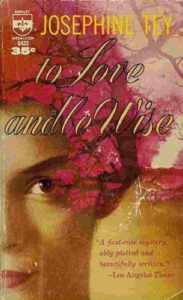
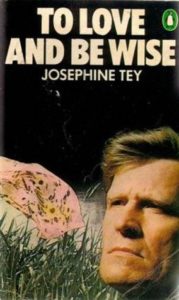
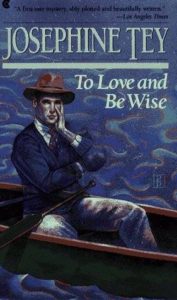
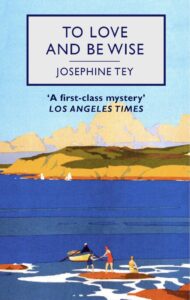
To Love and Be Wise (1950) was written by Elizabeth MacKintosh under her famous pen name, Josephine Tey (the ‘Tae’ in your query likely stems from a phonetic spelling or a scanner typo).
While it is structured as a classic Golden Age British detective mystery featuring Inspector Alan Grant, the entire plot hinges directly on trans-masculine presentation, female gender fluidness, and sapphic attraction. The mystery revolves around a dashing, beautiful young American male photographer named Leslie Searle who arrives in an English artistic colony, charms everyone, and then vanishes. It is ultimately revealed that Leslie Searle is actually a woman presenting seamlessly as a young man. The book heavily explores the homoerotic tension and intense infatuations that both men and women in the village develop toward Leslie before her true sex is revealed.
A seminal text in the history of queer detective fiction, Josephine Tey’s 1950 mystery subverts Golden Age tropes by centering its narrative on gender transgression and same-sex attraction. When the devastatingly handsome young American photographer Leslie Searle vanishes from a tight-knit English arts colony, Inspector Alan Grant is called in to investigate a suspected murder. The investigation uncovers a web of intense romantic fixation, revealing that Leslie had systematically charmed and manipulated the colony’s residents—disrupting both heterosexual engagements and sparking latent homoerotic desires. The novel’s eventual resolution hinges on a radical mid-century depiction of female masculinity, cross-dressing, and gender performance, making it a crucial historical piece for studying sapphic subtext and gender fluidity in classic crime fiction.
Josephine Tey's fourth Inspector Alan Grant mystery was published by Peter Davies in London in 1950 and by Macmillan in New York in 1951. Bradley's Checklist lists it beside Tey's Miss Pym Disposes, noting that once again a variant attachment supplies both the motive and the solution, and library catalogues file it under Lesbians.
The solution, which this comment gives away, turns on gender disguise. Leslie Searle, the handsome American photographer admired by the women of Salcott St Mary, whose disappearance Grant investigates, is revealed to be a woman. The lesbian element is coded rather than stated, in the manner of the Golden Age mystery, but it is the hinge of the plot and a good example of how crime fiction of the period handled what it could not name.


Comment
Josephine Tey's fourth Inspector Alan Grant mystery was published by Peter Davies in London in 1950 and by Macmillan in New York in 1951. Bradley's Checklist lists it beside Tey's Miss Pym Disposes, noting that once again a variant attachment supplies both the motive and the solution, and library catalogues file it under Lesbians.
The solution, which this comment gives away, turns on gender disguise. Leslie Searle, the handsome American photographer admired by the women of Salcott St Mary, whose disappearance Grant investigates, is revealed to be a woman. The lesbian element is coded rather than stated, in the manner of the Golden Age mystery, but it is the hinge of the plot and a good example of how crime fiction of the period handled what it could not name.