
Unlike Jane Austen or Dickens or George Eliot, most of the great novelists of the twentieth century have felt an immense pressure toward the autobiographical. When Virginia Woolf decided to become a novelist, around 1907-she was already 25 years old, a somewhat late starter-she practiced her craft by writing preliminary exercises; the most important of these sketches is an account of her childhood and adolescence, called ‘Reminiscences.’
Thus she begins her serious literary career as an autobiographer; and it may be said that she ends her literary career as an autobiographer as well, for during the last year and a half of her life she wrote ‘A Sketch of the Past,’ covering exactly the same experiences rehearsed 32 years before in the ‘Reminiscences.’ As an autobiographer, then, her principal concern is childhood: she draws her literary energies from her mythopoeia of her youth and refuses to face death until she has given her youth a more satisfying verbal form. D. H. Lawrence and James Joyce also wrote autobiographies, thinly disguised accounts of their development, soon after they became writers, but they did not share Virginia Woolf’s abiding obsession with autobiography; it is as if Lawrence and Joyce, in Sons and Lovers and A Portrait of the Artist as a Young Man, got it right the first time, while Virginia Woolf was left with a lifelong intractable struggle with the infantile.
As a young woman she tried on several occasions to keep a diary, but this resolution did not stick until 1915 when she began the enormous set of daybooks which she kept up more or less continually until her death in 1941. In the opinion of many, this project is one of the masterworks of modern letters. In many places in her diary she announces that her purpose is to provide material for her memoirs, to be written by an elderly Virginia Woolf, an alter ego often addressed in the diary as a presiding dowager queen. Of course when she did come to write her memoirs, in 1939, she abandoned herself at about the age of 21, as if the adult Virginia Woolf were in no need of literary recall. However, the diary itself constitutes a kind of autobiography, though an autobiography of an oddly loquacious, yet oddly reticent sort.
Therefore we have two elaborately shaped narratives of childhood, both of them concocted with every literary resource, neither of which extends so far as her father’s death in 1904; an astonishingly replete record of the years of her full maturity, 1915-1941 (except for 1916, a year of illness); and, to cover the gaps, three papers which she wrote for the Memoir Club of Bloomsbury, the first two of which describe the quality of her life from late adolescence until 1912.
But of her marriage to Leonard Woolf, in 1912, she has scarcely a word to say anywhere. Indeed the period from 1907, when she began her first novel, The Voyage Out, until the beginning of the first World War, seems to have required almost no self-explanation. All the autobiographical writings I have mentioned, except the diary, are collected in a handy volume called Moments of Being; these writings, with the diary and the novel, To the Lighthouse, constitute Virginia Woolf’s attempt to elucidate her being. ~ Daniel Albright, portion taken from The Kenyon Review, New Series, Vol. 6, No. 4 (Autumn, 1984)
Genre: Autobiography/Biography; Grier Rated
Subjects: Authors, English; Literary Criticism / European / English, Irish, Scottish, Welsh; Novelists, English; Novelists, English - 20th Century - Biography; Novelists, English - Biography; Women Novelists, English - Biography; Woolf, Virginia
Publication History
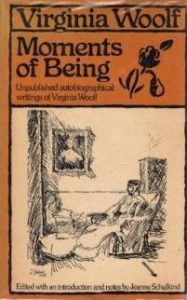
| ISBN | 9780701204549 |
|---|---|
| Copyright Date | 1978 |
| Publication Date | 1978 |
| Publisher | Hogarth Press |
| Language | English |
| Notes | '...All seemed transparent, for a moment, to the gaze of Fanny Wilmot, as if looking through Miss Craye, she saw the very fountain of her being spurting its pure silver drops. She saw back and back into the past behind her. She saw the green Roman vases stood in their case; heard the choristers playing cricket; saw Julia quietly descend the curving steps on to the lawn; then saw her pour out tea beneath the cedar tree; softly enclosed the old man's hand in hers; saw her going round and about the corridors of that ancient Cathedral dwelling place with towels in her hand to mark them; lamenting, as she went, the pettiness of daily life; and slowly ageing, and putting away clothes when summer came, because at her age they were too bright to wear; and tending her father's sickness; and cleaving her way ever more definitely as her will stiffened towards her solitary goal; travelling frugally; counting the cost and measuring out of her tight shut purse the sum needed for this journey or for that old mirror; obstinately adhering, whatever people might say, in choosing her pleasures for herself. She saw Julia— Julia blazed. Julia kindled. Out of the night she burnt like a dead white star. Julia opened her arms. Julia kissed her on the lips. Julia possessed it. 'Slater's pins have no points,' Miss Craye said, laughing queerly and relaxing her arms, as Fanny Wilmot pinned the flower to her breast with trembling fingers.' |
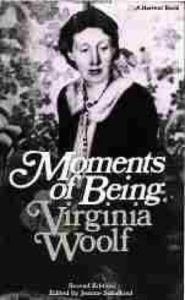
| ISBN | 9780156619189 |
|---|---|
| Copyright Date | 1985 |
| Publication Date | August 23, 1985 |
| Publisher | Harvest Books |
| Format | Paperback |
| No. of Pages | 240 |
| Language | English |
| Notes | '...All seemed transparent, for a moment, to the gaze of Fanny Wilmot, as if looking through Miss Craye, she saw the very fountain of her being spurting its pure silver drops. She saw back and back into the past behind her. She saw the green Roman vases stood in their case; heard the choristers playing cricket; saw Julia quietly descend the curving steps on to the lawn; then saw her pour out tea beneath the cedar tree; softly enclosed the old man's hand in hers; saw her going round and about the corridors of that ancient Cathedral dwelling place with towels in her hand to mark them; lamenting, as she went, the pettiness of daily life; and slowly ageing, and putting away clothes when summer came, because at her age they were too bright to wear; and tending her father's sickness; and cleaving her way ever more definitely as her will stiffened towards her solitary goal; travelling frugally; counting the cost and measuring out of her tight shut purse the sum needed for this journey or for that old mirror; obstinately adhering, whatever people might say, in choosing her pleasures for herself. She saw Julia— Julia blazed. Julia kindled. Out of the night she burnt like a dead white star. Julia opened her arms. Julia kissed her on the lips. Julia possessed it. 'Slater's pins have no points,' Miss Craye said, laughing queerly and relaxing her arms, as Fanny Wilmot pinned the flower to her breast with trembling fingers.' |

| ISBN | 9780586073261 |
|---|---|
| Copyright Date | 1989 |
| Publication Date | 1989 |
| Publisher | Grafton Books |
| No. of Pages | 249 |
| Language | English |
| Notes | '...All seemed transparent, for a moment, to the gaze of Fanny Wilmot, as if looking through Miss Craye, she saw the very fountain of her being spurting its pure silver drops. She saw back and back into the past behind her. She saw the green Roman vases stood in their case; heard the choristers playing cricket; saw Julia quietly descend the curving steps on to the lawn; then saw her pour out tea beneath the cedar tree; softly enclosed the old man's hand in hers; saw her going round and about the corridors of that ancient Cathedral dwelling place with towels in her hand to mark them; lamenting, as she went, the pettiness of daily life; and slowly ageing, and putting away clothes when summer came, because at her age they were too bright to wear; and tending her father's sickness; and cleaving her way ever more definitely as her will stiffened towards her solitary goal; travelling frugally; counting the cost and measuring out of her tight shut purse the sum needed for this journey or for that old mirror; obstinately adhering, whatever people might say, in choosing her pleasures for herself. She saw Julia— Julia blazed. Julia kindled. Out of the night she burnt like a dead white star. Julia opened her arms. Julia kissed her on the lips. Julia possessed it. 'Slater's pins have no points,' Miss Craye said, laughing queerly and relaxing her arms, as Fanny Wilmot pinned the flower to her breast with trembling fingers.' |
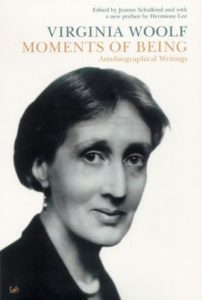
| ISBN | 9780712646185 |
|---|---|
| Copyright Date | 2002 |
| Publication Date | October 3, 2002 |
| Publisher | Pimlico |
| Format | Paperback |
| No. of Pages | 208 |
| Language | English |
| Notes | '...All seemed transparent, for a moment, to the gaze of Fanny Wilmot, as if looking through Miss Craye, she saw the very fountain of her being spurting its pure silver drops. She saw back and back into the past behind her. She saw the green Roman vases stood in their case; heard the choristers playing cricket; saw Julia quietly descend the curving steps on to the lawn; then saw her pour out tea beneath the cedar tree; softly enclosed the old man's hand in hers; saw her going round and about the corridors of that ancient Cathedral dwelling place with towels in her hand to mark them; lamenting, as she went, the pettiness of daily life; and slowly ageing, and putting away clothes when summer came, because at her age they were too bright to wear; and tending her father's sickness; and cleaving her way ever more definitely as her will stiffened towards her solitary goal; travelling frugally; counting the cost and measuring out of her tight shut purse the sum needed for this journey or for that old mirror; obstinately adhering, whatever people might say, in choosing her pleasures for herself. She saw Julia— Julia blazed. Julia kindled. Out of the night she burnt like a dead white star. Julia opened her arms. Julia kissed her on the lips. Julia possessed it. 'Slater's pins have no points,' Miss Craye said, laughing queerly and relaxing her arms, as Fanny Wilmot pinned the flower to her breast with trembling fingers.' |
Comment
Moments of Being is Virginia Woolf's short story, first published in the American magazine Forum in January 1928 as "Slater's Pins Have No Points." An earlier version appeared after her death as "Moments of Being: A Story" in the magazine Decision in May 1941, and the story was collected as "Moments of Being: 'Slater's Pins Have No Points'" in A Haunted House (1944).
The whole story takes place in the time it takes Fanny Wilmot to search a music-room floor for a pin, after a rose falls from her dress at the end of a piano lesson. As she looks, Fanny pieces together the life of her teacher, the unmarried Julia Craye, from scraps of small talk and gossip, and the story ends with Julia kissing her.
Woolf wrote it during her love affair with Vita Sackville-West, and in a letter to Vita in July 1927 she called it a "nice little story about Sapphism, for the Americans." It has drawn steady attention in lesbian readings of Woolf, among them Susan Clements's essay "The Point of 'Slater's Pins'" (1994) and an essay pairing it with Katherine Mansfield's "Carnation" in the collection Virginia Woolf: Lesbian Readings (1997).