

One of the few really good treatments of lesbian attachments in a girl’s reform school. Bessie, a wayward girl, is sent to a “good” reform school; at this stage she is naive, fairly innocent and presumably redeemable. The loneliness, the sadistic persecution by the corrupt or hardened matrons, and the “racket”—the enforced division of the school into “moms” and “pops”, by hardened young girl hooligans who like the power it gives them, and permitted by the matrons under the self-deception that these attachments are normal, schoolgirlish crushes—finally complete the girl’s corruption until it is certain that she will come out of school a confirmed young criminal, Sara Harris is herself a social worker; this painfully accurate picture of what our juvenile authorities contend with may, at least, give some insight into why the police and social agencies tend to be so violently anti-lesbian, It is hard to forget the picture painted in this book of the frightened Bessie insisting “I don’t never do no lovin’ with girls.’”—and the threats made to her. An absolute MUST book—on the other side. ~ Marion Zimmer Bradley
Genre: Pulp
Subjects: Lesbian prisoners -- Fiction; Lesbians - Fiction; Lesbians in reformatories - fiction
Publication History
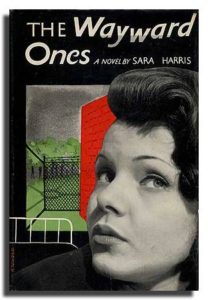
| Copyright Date | 1952 |
|---|---|
| Publication Date | 1952 |
| Publisher | Crown |
| Format | Hardcover |
| No. of Pages | 220 |
| Language | English |
| Rating | Great |
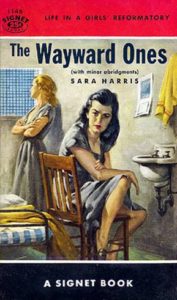
| Copyright Date | 1952 |
|---|---|
| Publication Date | 1954 |
| Publisher | Signet |
| Format | Mass Market Paperback |
| No. of Pages | 128 |
| Language | English |
| Notes | Signet 1146 |
| Rating | Great |
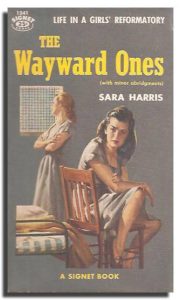
| Copyright Date | 1952 |
|---|---|
| Publication Date | 1956 |
| Publisher | Signet |
| Format | Mass Market Paperback |
| No. of Pages | 128 |
| Language | English |
| Notes | Signet Book 1341 |
| Rating | Great |
Comment
The Wayward Ones, by the social worker and journalist Sara Harris, was published by Crown in 1952, and Signet paperback editions followed in the mid-1950s. It is a fictionalized account of life in a girls' reformatory. Bessie arrives naive and apparently redeemable, but loneliness, cruel matrons and a racket run by hardened inmates, who divide the school into moms and pops while the staff dismiss these attachments as schoolgirl crushes, gradually wear her down.
Marion Zimmer Bradley marked it in her 1960 Checklist as a book of considerable value and praised it as one of the rare good treatments of lesbian attachments in a girls' reform school. The sociologist Erving Goffman cited it in Asylums (1961) as a fictional picture of arrival at a girls' reformatory. It is an early and serious portrait of how relationships between girls in institutions were seen and policed in the 1950s, by a writer who knew such places from her work.