

The act of ‘coming out’ has the power to transform every aspect of a woman’s life: family, friendships, career, sexuality, spirituality. An essential element of self-realization, it is the unabashed acceptance of one’s ‘outlaw’ standing in a predominantly heterosexual world.
These accounts — sometimes heart-wrenching, often exhilarating — encompass a wide breadth of backgrounds and experiences. From a teenager institutionalized for her passion for women to the mother who must come out to her young sons at the risk of losing them — from the cautious academic to the raucous liberated femme — each woman represented here tells of forging a unique path toward the difficult but emancipating recognition of herself. Extending from the 1940s to the present day, these intensely personal stories in turn reflect a unique history of the changing social mores that affected each woman’s ability to determine the shape of her own life. Together they form an ornate tapestry of lesbian and bisexual experience in the United States over the past half-century.
Genre: Anthology - Fiction; Award Winner; Coming Out
Publication History
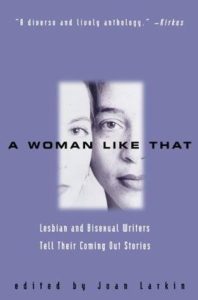
| ISBN | 9780380976980 |
|---|---|
| Copyright Date | 1999 |
| Publication Date | October 1, 1999 |
| Publisher | William Morrow |
| Format | Hardcover |
| No. of Pages | 352 |
| Language | English |
| Notes | Lambda Literary Award Finalist |
| Rating | Good |
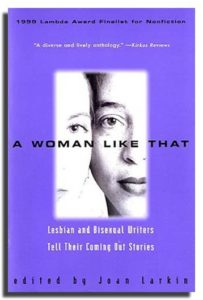
| ISBN | 9780380802470 |
|---|---|
| Copyright Date | 1999 |
| Publication Date | November 1, 2000 |
| Publisher | Harper Paperbacks |
| Format | Trade Paperback |
| No. of Pages | 352 |
| Language | English |
| Notes | Lambda Literary Award Finalist |
| Rating | Good |
Comment
A Woman Like That: Lesbian and Bisexual Writers Tell Their Coming Out Stories, edited by the poet Joan Larkin, was published by William Morrow in 1999, with a Harper paperback in 2000. Larkin invited thirty-one writers, among them Bertha Harris, Eva Kollisch and Lesléa Newman, to write about coming out. In her introduction she explains that many of them treat it as a continuum of experience rather than a single moment, and that several found the memories unexpectedly painful to revisit.
It was a finalist for the Lambda Literary Award for nonfiction anthologies at the twelfth awards. Publishers Weekly observed that because Larkin chose mostly established writers, the book leans toward the lesbian feminist years of the 1970s and 1980s, which also makes it a record of that generation. Larkin had co-edited the anthologies Amazon Poetry (1975) and Lesbian Poetry (1981) with Elly Bulkin.