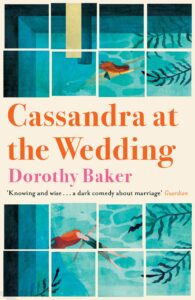
Cassandra Edwards is a graduate student at Berkeley: gay, brilliant, nerve-wracked, miserable. At the beginning of this novel, she drives back to her family ranch in the foothills of the Sierras to attend the wedding of her identical twin, Judith, to a nice young doctor from Connecticut. Cassandra, however, is hell-bent on sabotaging the wedding. Dorothy Baker‘s entrancing tragicomic novella follows an unpredictable course of events in which her heroine appears variously as conniving, self-aware, pitiful, frenzied, absurd, and heartbroken—at once utterly impossible and tremendously sympathetic. Cassandra reckons with her complicated feelings about the sister who she feels owes it to her to be her alter ego; with her father, a brandy-soaked retired professor of philosophy; and with the ghost of her dead mother, as she struggles to come to terms with the only life she has. First published in 1962, Cassandra at the Wedding is a book of enduring freshness, insight, and verve. Like the fiction of Jeffrey Eugenides and Jhumpa Lahiri, it is the work of a master stylist with a profound understanding of the complexities of the heart and mind. — ‘A very special love story’ ~ Barbara Grier, The Ladder, V.7 N.4, January 1963
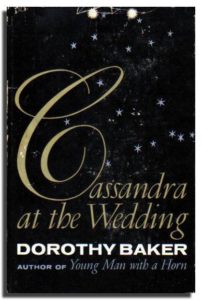
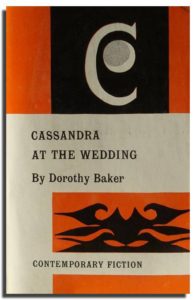
Cassandra at the Wedding, published by Houghton Mifflin in 1962, was Dorothy Baker's last novel and is often called her masterpiece. Cassandra Edwards, a brilliant, unhappy graduate student at Berkeley, drives home to the family ranch for the wedding of her identical twin, Judith, intending to stop it. The novel never names Cassandra's sexuality, but it is clear that she has had relationships with women at Berkeley, and readers have long recognized her as a lesbian heroine.
Baker had paid a price for writing about women who love women. Her second novel, Trio (1943), concerned a relationship between a professor and her student, and the Broadway adaptation was shut down within months of its opening in December 1943 by protesters outraged at its lesbian theme. Cassandra handles the subject far more obliquely, and some readers see its restraint as a response to that experience.
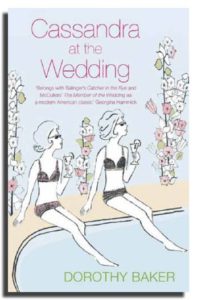
New York Review Books Classics reissued the novel with an afterword by Deborah Eisenberg, followed by editions from Virago and Daunt Books, and in 2022 the film company Neon bought the screen rights, with Sarah DeLappe to write the adaptation.



Comment
Cassandra at the Wedding, published by Houghton Mifflin in 1962, was Dorothy Baker's last novel and is often called her masterpiece. Cassandra Edwards, a brilliant, unhappy graduate student at Berkeley, drives home to the family ranch for the wedding of her identical twin, Judith, intending to stop it. The novel never names Cassandra's sexuality, but it is clear that she has had relationships with women at Berkeley, and readers have long recognized her as a lesbian heroine.
Baker had paid a price for writing about women who love women. Her second novel, Trio (1943), concerned a relationship between a professor and her student, and the Broadway adaptation was shut down within months of its opening in December 1943 by protesters outraged at its lesbian theme. Cassandra handles the subject far more obliquely, and some readers see its restraint as a response to that experience.
New York Review Books Classics reissued the novel with an afterword by Deborah Eisenberg, followed by editions from Virago and Daunt Books, and in 2022 the film company Neon bought the screen rights, with Sarah DeLappe to write the adaptation.