
From Publishers Weekly Lesbian writer Schulman follows her well-received After Delores and People in Trouble with this insightful allegory, which explores the feminine and masculine qualities said to coexist within every personality. The novel is prefaced by a troubling quote from Freud, which alleges that lesbianism results from a woman’s frustrated Elektra complex and desire to punish her father. This theory is challenged by protagonist Anna O (meant to suggest a famous Freud patient), a lesbian secure in her attraction to women yet struggling with male sexism, her family’s homophobia and her feelings that she is unlovable. Anna consults ‘street-corner psychiatrist’ Doc, who roams New York’s Lower East Side and charges patients $10 an hour for his listening skills. Representing the female and male halves of a complete person, Anna and Doc discover that together they can confront conventional mores, their own guilt and a woman, symbolically clad in white leather, who broke their hearts. In a resolution that better serves the book’s allegorical aims than its dramatic development, Anna and Doc are composites that masquerade as characters. In a plain-spoken, often funny narrative, Schulman makes provocative statements about gender roles, sexual orientation, AIDS, homelessness, drugs and the therapeutic value of an attentive ear. Author tour. Copyright 1992 Reed Business Information, Inc. –This text refers to an out of print or unavailable edition of this title.
From Library Journal Anna, the main character in Schulman’s ( People in Trouble , LJ 1/90) new novel, tries to make some sense of her crazy, mixed-up life with the help of Doc, her therapist and alter ego. She wants to resolve the anger and resentment she feels toward her intolerant family so that she can accept herself. This work might better have been called Guilt , since her characters more often act out of guilt and embarrassment than any other feeling. Anna feels guilt for not helping the poor and homeless and for not being normal or feminine enough. She tells Doc that the most important thing to remember about families of lesbians is that ‘you just can’t outwit them. . . . No matter how normal you try to be, you’ll never be normal.’ The novel relies on characters who engage in dream sequences to make their points. Not very much plot action unfolds, but, while the dialog is at times offbeat and disjointed, it is always witty and irreverent. When the characters are unmasked at the end, readers will be surprised at the deftness with which this story is told. – Lisa Nussbaum, formerly with Cambria Cty. P.L., Johnstown, Pa. Copyright 1992 Reed Business Information, Inc. –This text refers to an out of print or unavailable edition of this title.
Genre: Fiction
Publication History
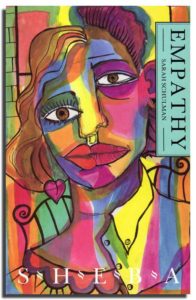
| ISBN | 9780907179634 |
|---|---|
| Copyright Date | 1993 |
| Publication Date | April 28, 1993 |
| Publisher | Sheba Feminist Press |
| Format | Trade Paperback |
| No. of Pages | 160 |
| Language | English |
| Rating | Not Rated |

| ISBN | 0452270499 |
|---|---|
| Copyright Date | 1992 |
| Publication Date | September 22, 1993 |
| Publisher | Plume |
| Format | Trade Paperback |
| No. of Pages | 192 |
| Language | English |
| Rating | Not Rated |

| ISBN | 1551522012 |
|---|---|
| Copyright Date | 1992 |
| Publication Date | May 1, 2006 |
| Publisher | Arsenal Pulp Press |
| Format | Trade Paperback |
| No. of Pages | 225 |
| Language | English |
| Rating | Not Rated |
Comment
Empathy is a novel by Sarah Schulman, published by Dutton in 1992 and reissued by Arsenal Pulp Press in its Little Sister's Classics series. The protagonist, Anna O., takes her name from Freud's famous patient. She is a lesbian on the Lower East Side who keeps falling for straight or bisexual women and who consults Doc, an unlicensed street-corner therapist who looks a great deal like her as a man.
The book opens with a quotation from Freud about the supposed origins of lesbianism and then spends its length arguing with it. Publishers Weekly noted how it takes on gender roles, sexual orientation, AIDS and homelessness in early-1990s New York. Its final chapters turn openly experimental, and the whole book is a direct challenge to the psychoanalytic tradition that had long defined lesbians as a problem to be explained.