She looked round the Cellar with Laura following her gaze. ‘I know most of the girls here…I’ve probably slept with half of them. I’ve lived with half of the half I’ve slept with. I’ve loved half of the half I’ve lived with.’
‘L for Love,’ Beebo said, looking into space. “L for Laura.’ She turned and smiled at her, “.L for Lust and L for the L of it, L for Lesbian, L for Let’s – let’s,’ she said, and blew smoke softly into Laura’s ear.
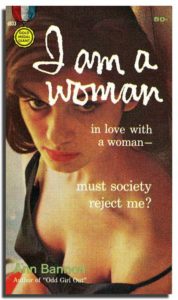
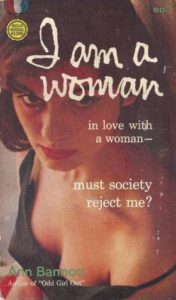
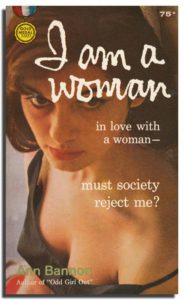
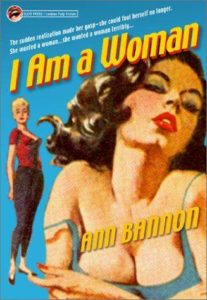
I Am a Woman, the second of Ann Bannon's novels, is the book that introduced Beebo Brinker. Gold Medal published it in 1959 under the full title I Am a Woman: In Love With a Woman, Must Society Reject Me? It picks up Laura Landon after Odd Girl Out as she arrives in Greenwich Village, befriends the wisecracking gay man Jack Mann, and falls in love with Beebo. Bannon later said that, unable to find a woman like Beebo in the Village, she created her: "the butch of my dreams."
The book's ending, in which Laura and Beebo end up together, broke with the miserable endings expected of lesbian fiction, and letters began to reach Bannon from all over the country. The Ladder and ONE both reviewed it in 1959, and Gene Damon's 1969 survey of lesbian paperbacks called it a blockbuster and singled out Beebo's barroom seduction scene as a classic. Some historians credit the book with drawing thousands of young lesbians to Greenwich Village.
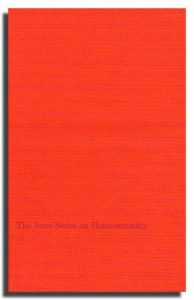
The novel was reprinted by Arno Press in 1975, by Naiad Press in 1983 under the shorter title, and by Cleis Press in 2002 with a new introduction by Bannon. Beebo has remained one of the best-known characters in lesbian fiction.




Comment
I Am a Woman, the second of Ann Bannon's novels, is the book that introduced Beebo Brinker. Gold Medal published it in 1959 under the full title I Am a Woman: In Love With a Woman, Must Society Reject Me? It picks up Laura Landon after Odd Girl Out as she arrives in Greenwich Village, befriends the wisecracking gay man Jack Mann, and falls in love with Beebo. Bannon later said that, unable to find a woman like Beebo in the Village, she created her: "the butch of my dreams."
The book's ending, in which Laura and Beebo end up together, broke with the miserable endings expected of lesbian fiction, and letters began to reach Bannon from all over the country. The Ladder and ONE both reviewed it in 1959, and Gene Damon's 1969 survey of lesbian paperbacks called it a blockbuster and singled out Beebo's barroom seduction scene as a classic. Some historians credit the book with drawing thousands of young lesbians to Greenwich Village.
The novel was reprinted by Arno Press in 1975, by Naiad Press in 1983 under the shorter title, and by Cleis Press in 2002 with a new introduction by Bannon. Beebo has remained one of the best-known characters in lesbian fiction.