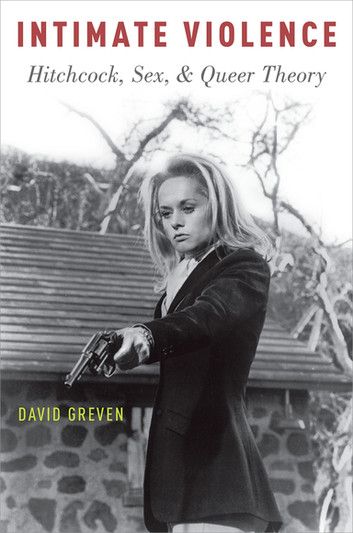
Intimate Violence examines the persistent tension in Alfred Hitchcock’s films between heterosexual heroines and queer characters, most often—but not exclusively—male. Rather than centering narrative authority on the male hero, Hitchcock’s work frequently allows female and queer figures to compete for control of the story, placing them in conflicted relation to one another. These struggles mirror the uneasy relationship between feminist and queer theory.
Drawing on a reparative psychoanalytic framework, David Greven brings feminist and queer approaches together through the theories of Melanie Klein. He argues that Hitchcock’s films repeatedly stage a conflict between impulses to harm and impulses to repair the loved object. From this analysis, Greven develops a theory of sexual hegemony, describing what he terms the “feminine versus the queer conflict.” While heroines remain vulnerable to misogyny, they often gain limited forms of agency that queer characters desire but cannot access in the same way, mistaking partial autonomy for social power.
Queer figures in Hitchcock’s films, however, possess their own form of influence through masquerade, illusion, and seduction—modes of power that challenge the heroine’s drive toward knowledge and resolution. Using Freud’s theory of paranoia as a lens for examining cultural homophobia, Greven illuminates patterns of homoerotic antagonism and gendered conflict across Hitchcock’s body of work. Close readings of North by Northwest, Psycho, Strangers on a Train, Spellbound, Rope, Marnie, and The Birds reveal the simultaneous attraction to and fear of same-sex desire that structures these films.
Details
| ISBN | 9780190214173 |
|---|---|
| Copyright Date | 2017 |
| Publication Date | March 13, 2017 |
| Publisher | Oxford University Press |
| Format | Paperback |
| No. of Pages | 280 |
| Language | English |
| Genre | Literary Criticism |
| Subject | Homosexuality in motion pictures; Violence In Motion Pictures; Women In Motion Pictures |