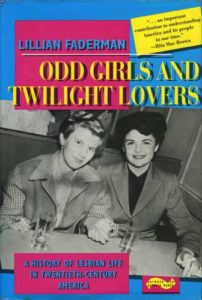
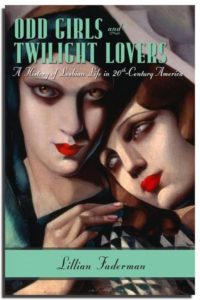
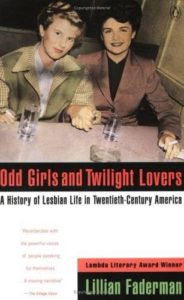
This compelling story of lesbian life in the twentieth century traces the evolution of lesbian identity and subcultures from the early years of the century–when career opportunities first enabled women to support themselves and spend their lives in ‘romantic friendships’ with other women–to the diversity of today’s life styles. Faderman uses journals, unpublished manuscripts, songs, news accounts, novels, medical literature, and numerous personal interviews with lesbians of all races, ages, and classes, to uncover and relate this often surprising narrative of lesbian life in America. Lesbian identity could emerge, Faderman maintains, only during that time, with the sexual freedom of the 1920s and the 1960s, as well as the social freedom made possible by World War II, the education of women, and the civil rights and women’s movements. The term ‘lesbian’ did not become current until the late nineteenth century, when European sexologists began to explore female same-sex loving. Where close relationships between women had once been accepted–even encouraged–the sexologists stigmatized same-sex pairing as deviant, but at the same time fostered a lesbian consciousness which was necessary before lesbian communities could be formed. This book tells how women who accepted the label ‘lesbian’ altered the sexologists’ definitions, creating identities and ideologies for themselves.–Adapted from book jacket.
Odd Girls and Twilight Lovers: A History of Lesbian Life in Twentieth-Century America was published by Columbia University Press in 1991. Where Faderman's Surpassing the Love of Men surveyed five centuries, this book concentrates on one, following American lesbian life from the romantic friendships and sexological labels of the early 1900s through the bohemian 1920s, the war years, the bars and witch-hunts of the 1950s, and lesbian feminism, to the more varied communities of the 1980s. It draws on journals, unpublished manuscripts, songs, novels, medical literature, popular culture and many interviews with lesbians themselves.
It won the American Library Association's Stonewall Book Award for nonfiction in 1992, was the Editor's Choice at the Lambda Literary Awards, and was a New York Times Notable Book of 1992. Francine Prose in the Los Angeles Times praised it as full of facts and wonderful details, and Barbara Grier, reviewing it in the Lambda Book Report, called it a wonder. In 2011 Ms. magazine ranked it among the hundred best feminist nonfiction books.
It is often called a classic of LGBT history, and Columbia keeps it in print.


Comment
Odd Girls and Twilight Lovers: A History of Lesbian Life in Twentieth-Century America was published by Columbia University Press in 1991. Where Faderman's Surpassing the Love of Men surveyed five centuries, this book concentrates on one, following American lesbian life from the romantic friendships and sexological labels of the early 1900s through the bohemian 1920s, the war years, the bars and witch-hunts of the 1950s, and lesbian feminism, to the more varied communities of the 1980s. It draws on journals, unpublished manuscripts, songs, novels, medical literature, popular culture and many interviews with lesbians themselves.
It won the American Library Association's Stonewall Book Award for nonfiction in 1992, was the Editor's Choice at the Lambda Literary Awards, and was a New York Times Notable Book of 1992. Francine Prose in the Los Angeles Times praised it as full of facts and wonderful details, and Barbara Grier, reviewing it in the Lambda Book Report, called it a wonder. In 2011 Ms. magazine ranked it among the hundred best feminist nonfiction books.
It is often called a classic of LGBT history, and Columbia keeps it in print.