From the author’s notes: This Parable, with its notations and evocations of naked nerves and soul-states, is inscribed in all gratitude to the charming morganatic ladies, les belles impures, who make pleasanter this vale of tears for virile men. What shall it profit a woman if she saves her soul, but loseth love? Now the seven deadly virtues are: Humility, Charity, Meekness, Temperance, Brotherly Love, Diligence and Chastity. And the Seven Deadly Arts are: Poetry, Music, Architecture, Painting, Sculpture, Drama and Dancing. The book begins: Until the day of her death Easter never forgot that first night in New York. It was the initial twist of her ship’s wheel, and the commonplace happenings which followed her entrance into the Maison Felice were to give force and direction to her entire life. — Unpleasant novel of the theatrical and literary world of that day; the heroine, Easter, (an opera singer) has a mannish hanger-on.
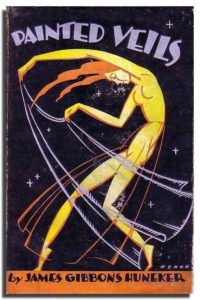
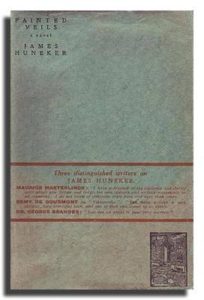
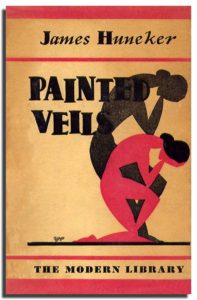
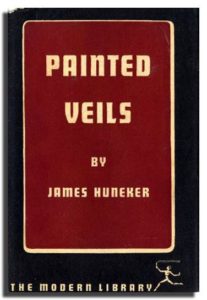
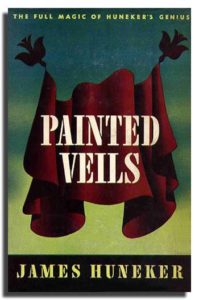
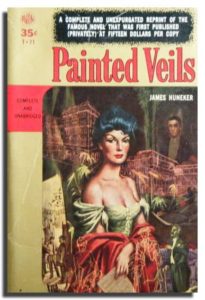
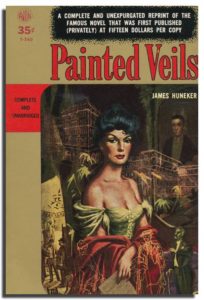
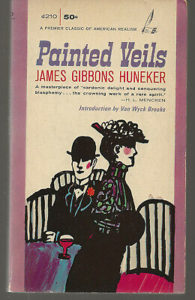
James Huneker was the leading American music and literary critic of his day, and Painted Veils, written in about six weeks in 1919, is his best-known book. Boni and Liveright issued it in 1920 in a limited edition of 1,200 copies, signed by the author and sold privately at fifteen dollars a copy. Trade editions followed, including a numbered edition of 2,300 copies in 1928, the Modern Library from 1930 to 1942, and later paperbacks advertised as complete and unexpurgated.
The novel follows Easter Brandes, a young woman who arrives in bohemian New York and becomes a celebrated singer, with her progress framed by the myth of Istar passing through the seven gates of the underworld. It opens with an epigraph about Lesbians, and lesbian desire runs through its account of Easter's affairs. The treatment belongs to its period, with sapphism presented as one of the sensual sins of an artistic life, but Barbara Grier's bibliography The Lesbian in Literature gave it an A rating for major lesbian content, and it is held today in collections such as the Lesbian Pulp Fiction Collection at Mount Saint Vincent University.



Comment
James Huneker was the leading American music and literary critic of his day, and Painted Veils, written in about six weeks in 1919, is his best-known book. Boni and Liveright issued it in 1920 in a limited edition of 1,200 copies, signed by the author and sold privately at fifteen dollars a copy. Trade editions followed, including a numbered edition of 2,300 copies in 1928, the Modern Library from 1930 to 1942, and later paperbacks advertised as complete and unexpurgated.
The novel follows Easter Brandes, a young woman who arrives in bohemian New York and becomes a celebrated singer, with her progress framed by the myth of Istar passing through the seven gates of the underworld. It opens with an epigraph about Lesbians, and lesbian desire runs through its account of Easter's affairs. The treatment belongs to its period, with sapphism presented as one of the sensual sins of an artistic life, but Barbara Grier's bibliography The Lesbian in Literature gave it an A rating for major lesbian content, and it is held today in collections such as the Lesbian Pulp Fiction Collection at Mount Saint Vincent University.