

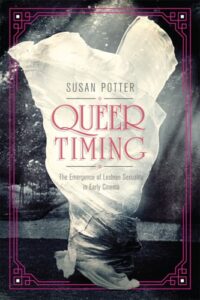
In Queer Timing, Susan Potter offers a counter-history that reorients accepted views of lesbian representation and spectatorship in early cinema. Potter sees the emergence of lesbian figures as only the most visible but belated outcome of multiple sexuality effects. Early cinema reconfigured older erotic modalities, articulated new–though incoherent–sexual categories, and generated novel forms of queer feeling and affiliation.
Potter draws on queer theory, silent film historiography, feminist film analysis, and archival research to provide an original and innovative analysis. Taking a conceptually oriented approach, she articulates the processes of filmic representation and spectatorship that reshaped, marginalized, or suppressed women’s same-sex desires and identities. As she pursues a sense of ‘timing, ‘ Potter stages scenes of the erotic and intellectual encounters shared by historical spectators, on-screen figures, and present-day scholars.
The result is a daring revision of feminist and queer perspectives that foregrounds the centrality of women’s same-sex desire to cinematic discourses of both homo- and heterosexuality.
Genre: Award Winner; Fiction; LGBT Studies/Social Sciences; Movie/Media Tie-In
Subjects: Lesbianism In Motion Pictures; Lesbians in motion pictures; Motion pictures - History
Publication History
| ISBN | 9780252051302 |
|---|---|
| Copyright Date | 2019 |
| Publication Date | 2019 |
| Publisher | University Of Illinois Press |
| Format | Digital/E-Book |
| No. of Pages | 240 |
| Language | English |
| Notes | John Leo and Dana Heller Award for Best Single Work, Anthology, Multi-Authored or Edited Book in LGBTQ Studies, Popular Culture Association (PCA), 2020. |
| Rating | Great |

| ISBN | 9780252084249 |
|---|---|
| Copyright Date | 2019 |
| Publication Date | June 16, 2019 |
| Publisher | University Of Illinois Press |
| Format | Trade Paperback |
| No. of Pages | 238 |
| Language | English |
| Rating | Not Rated |
Comment
Queer Timing: The Emergence of Lesbian Sexuality in Early Cinema (University of Illinois Press, 2019), by the University of Sydney film scholar Susan Potter, is a counter-history of lesbian representation and spectatorship in early film. Drawing on queer theory, film history and archival research, Potter argues that women's same-sex desire was central to the way early cinema imagined both homosexuality and heterosexuality. Her chapters move from Pandora's Box and A Florida Enchantment to The Wild Party, the dancer Loïe Fuller and the queer appeal of Rudolph Valentino's stardom.
It won the Popular Culture Association's John Leo and Dana Heller Award for the best single work in LGBTQ studies in 2020.