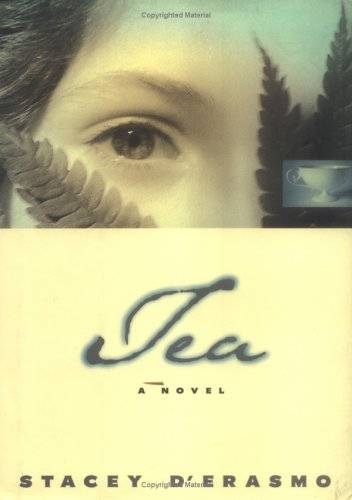

Stacey D’Erasmo will be a familiar name to anyone who reads the Village Voice. During the years she worked at that quintessential alternative weekly, her beautiful, trenchant essays were among the paper’s real drawing cards. Writing on a wide variety of topics–from the brainlessness of certain ‘do me’ feminists to the arrest of ex-’60s radical Katherine Ann Power–D’Erasmo always managed to distill her response into a few devastating elements, her prose driven by quiet rage and an impatient, electric poetry. Like the political writing of Joan Didion, these have proven to be unforgettable essays that deserve to be collected soon. All of which brings us to Tea, D’Erasmo’s first work of fiction. Essentially a coming-of-age tale, it’s divided into three periods in the life of one Isabel Gold–from girlhood through her early 20s. The first section, ‘Morning,’ is weakest, full of the familiar tropes of damaged childhood: the beautiful suicidal mother, the passive, clever narrator who keeps staring out the car window. But as the book picks up, D’Erasmo sharpens her focus, and Isabel’s world takes on a vibrant particularity and humor. Here, for instance, is a slyly hilarious description of a film project she and her girlfriend are working on: Their film was experimental; it incorporated all the theories they both knew about film, but, they both felt certain, went beyond those theories…. It didn’t have a title yet; they couldn’t find the phrase that encompassed, or referenced, all the myriad things their film was. It was political. It was nonlinear. It was diffuse. It made use of film as film. Passages like this call to mind the early-1990s film Go Fish, which also took place in an East Coast world of smart, gay women just out of college who are settling into an urban subculture and making homes in a city where their desires can be easily expressed and absorbed. Fans of that film’s liberal-arts-grad realism will welcome Tea. But readers who have anxiously followed D’Erasmo’s work may chafe when coming across details such as Pier 1 rattan chairs, La-Z-Boy recliners, and Hill Street Blues–specifics that can date and sometimes diminish this intermittently powerful work. –Emily White
Genre: Award Winner; Fiction
Publication History

| ISBN | 9780743400589 |
|---|---|
| Copyright Date | 2000 |
| Publication Date | January 1, 2001 |
| Publisher | Washington Square Press |
| Format | Trade Paperback |
| No. of Pages | 352 |
| Language | English |
| Rating | Great |
| ISBN | 1565122437 |
|---|---|
| Copyright Date | 2000 |
| Publication Date | March 19, 2004 |
| Publisher | Workman Publishing |
| Format | Hardcover |
| No. of Pages | 317 |
| Language | English |
| Rating | Great |
Comment
Tea (Algonquin, 2000) was Stacey D'Erasmo's first novel. In 1968, eight-year-old Isabel Gold sets out tea for her moody mother in Philadelphia, and her mother's suicide that year shapes all that follows. Told in three sections, Morning, Afternoon and Evening, the novel follows Isabel through the 1970s and after as she finds her way into the theater, realizes she is a lesbian, falls in love with a woman and suffers her first heartbreak.
It was a New York Times Notable Book for 2000 and a finalist for the Lambda Literary Award for Lesbian Fiction at the thirteenth awards (2001). D'Erasmo, a former editor at the Voice Literary Supplement, went on to win that award for her second novel, A Seahorse Year (2004).