

She Came To Hollywood looking for the answer to the strange hunger in her blood. But not until she met Betty, the tantalizing, voluptuous slut, could she put a name to the passion that was consuming her. The tragic drama of their encounter unwound against the sordid backdrop of Hollywood’s prostitutes and procurers, misfits and rejects–and then exploded in a shocking, and inevitable, climax.
‘A lucid, penetrating novel about the illicit love her heroine, Margory Vulawski, feels for the beautiful slut, Betty. The background to this affair is Hollywood. It is her strange destiny to want to become her dumb, bestial father. She can only feel loathing and disgust for the fact that her flesh is a woman’s,’ (from front flap).
Genre: Grier Rated; Pulp
Subjects: Lesbians - Fiction
Publication History
| Copyright Date | 1962 |
|---|---|
| Publication Date | 1962 |
| Publisher | Spearman |
| Format | Mass Market Paperback |
| No. of Pages | 159 |
| Language | English |
| Rating | Great |
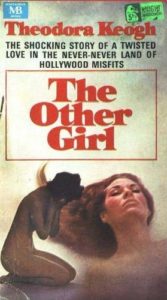
| Copyright Date | 1962 |
|---|---|
| Publication Date | 1967 |
| Publisher | Macfadden |
| Format | Mass Market Paperback |
| No. of Pages | 128 |
| Language | English |
| Notes | MacFadden 60-289 |
| Rating | Great |
Comment
The Other Girl (Neville Spearman, London, 1962) was the last novel Theodora Keogh published before she gave up writing. It fictionalizes the 1947 Los Angeles murder of Elizabeth Short, the Black Dahlia, and it has been read both as psychological suspense and as lesbian fiction. The Mattachine Review in 1963 called it a serious novel that treats with understanding a kind of lesbian whom most people shun. Keogh (1919 to 2008) published nine novels between 1950 and 1962, and a 2011 essay in The Paris Review notes that homosexual characters are the protagonists of two of them, The Double Door and The Other Girl.