First published in Paris in 1894, The Songs of Bilitis was presented as a translation of ancient Greek poems written by Bilitis, a supposed contemporary of Sappho. The book caused a sensation at the time, not only because the discovery of a new cache of ancient poetry would have been extraordinary, but also because of its candid and lyrical celebration of lesbian love. In truth, Bilitis never existed. The poems were an imaginative creation by Pierre Louÿs, who even included a fabricated bibliography and scholarly notes to lend credibility to the work. Louÿs, well-versed in classical literature, wove authentic references to figures like Sappho among his inventions, adding to the illusion.
The work itself is structured as a sequence of prose poems, presented in three sections corresponding to different periods of Bilitis’ imagined life: her idyllic youth in a pastoral village, her awakening to sensuality in the city of Mytilene under Sappho’s influence, and her later years as a courtesan in Cyprus. The poems are delicate, introspective, and often quietly erotic, evoking a world of natural beauty, emotional longing, and fleeting pleasures. Louÿs’ style captures a dreamlike, wistful tone that feels both timeless and intimately personal.
Despite its fictional origins — and its male authorship — The Songs of Bilitis gained lasting cultural importance, particularly within lesbian communities. One of the earliest lesbian organizations in the United States, the Daughters of Bilitis, took its name from this work, perhaps in part because the reference would pass unnoticed by outsiders. Throughout the early and mid-20th century, English translations of Bilitis were often considered daring enough to merit limited, privately printed editions.
Les Chansons de Bilitis, a collection of 143 prose poems by Pierre Louÿs, was published in Paris in 1894 and presented as Louÿs's translation of the work of Bilitis, a Greek courtesan who had lived on Lesbos and known Sappho. The poems follow her through three phases of her life, from girlhood to her love for Mnasidika on Lesbos and her years as a courtesan on Cyprus. Bilitis never existed, and Louÿs had even supplied a bogus scholarly apparatus, but the discovery did little to harm the book, which was admired for its sensuality and refinement and above all for its sympathetic portrayal of love between women.
Its place in lesbian history was sealed in 1955, when the founders of the first lesbian civil and political rights organisation in the United States named it the Daughters of Bilitis, a deliberately obscure name that only those who knew Louÿs's poems would recognise. Peggy Caserta later named her Haight-Ashbury boutique Mnasidika after one of its characters, and Claude Debussy set three of the poems for voice and piano. The Songs remain an important work for lesbian readers.
Alvah Bessie's English translation of 1926, illustrated by Willy Pogany, was followed by many other editions, including collected editions of Louÿs's works and paperback reprints.
Publication History
Copyright Date
1928
Publication Date
1928
Publisher
Fortune Press
Format
Hardcover
Language
English
Notes
Look for multiple editions, publishers and covers.
Rating
Great
Copyright Date
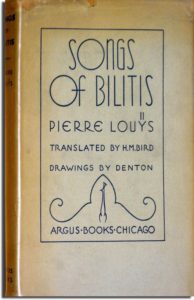
1931
Publication Date
1931
Publisher
Argus Books
Format
Hardcover
No. of Pages
177
Language
English
Rating
Great
Copyright Date
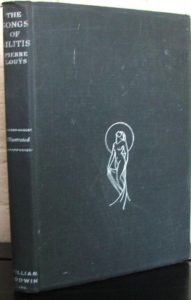
1933
Publication Date
1933
Publisher
William Godwin
Format
Hardcover
No. of Pages
163
Language
English
Notes
Look for multiple editions, publishers and covers.
Rating
Great
ISBN
9780486256702
Copyright Date
1988
Publication Date
June 1, 1988
Publisher
Dover Publications
Format
Trade Paperback
No. of Pages
192
Language
English
Notes
Look for multiple editions, publishers and covers.




Comment
Les Chansons de Bilitis, a collection of 143 prose poems by Pierre Louÿs, was published in Paris in 1894 and presented as Louÿs's translation of the work of Bilitis, a Greek courtesan who had lived on Lesbos and known Sappho. The poems follow her through three phases of her life, from girlhood to her love for Mnasidika on Lesbos and her years as a courtesan on Cyprus. Bilitis never existed, and Louÿs had even supplied a bogus scholarly apparatus, but the discovery did little to harm the book, which was admired for its sensuality and refinement and above all for its sympathetic portrayal of love between women.
Its place in lesbian history was sealed in 1955, when the founders of the first lesbian civil and political rights organisation in the United States named it the Daughters of Bilitis, a deliberately obscure name that only those who knew Louÿs's poems would recognise. Peggy Caserta later named her Haight-Ashbury boutique Mnasidika after one of its characters, and Claude Debussy set three of the poems for voice and piano. The Songs remain an important work for lesbian readers.
Alvah Bessie's English translation of 1926, illustrated by Willy Pogany, was followed by many other editions, including collected editions of Louÿs's works and paperback reprints.