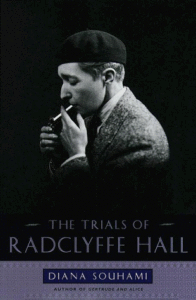
Diana Souhami‘s Lambda Award–winning biography is a fascinating look at one of the twentieth century’s most intriguing lesbian literary figures. Born in 1880, Marguerite Radclyffe-Hall was a young unwanted child when her parents put an end to their tempestuous marriage by filing for divorce. She had already made tentative forays into lesbian love when her father died, leaving her an heiress at eighteen. Her income assured, Hall moved out of her mother’s house, renamed herself John in honor of her great-great-grandfather, and divided her time among hunting, traveling, and pursuing women. She began to write—songs, poetry, prose, and short stories—and achieved success as a novelist, but it was with the publication of The Well of Loneliness in 1928 that Radclyffe Hall became an internationally known figure. Dubbed the ‘bible of lesbianism, ‘ the book caused a scandal on both sides of the Atlantic. Though moralistic in tone, because of its subject matter it was tried as obscene in America and in the United Kingdom, where it was censored under the Obscene Publications Act. The Trials of Radclyffe Hall is a fascinating, no-holds-barred account of the life of this controversial woman, including her torrid relationship with the married artist Una Troubridge, who was Hall’s devoted partner for twenty-eight years.
The Trials of Radclyffe Hall was published by Weidenfeld & Nicolson in London in 1998. Its title has a double meaning: the 1928 prosecution of The Well of Loneliness, which was banned solely because of its lesbian subject, and the personal trials of Hall's stormy character and emotional life. Souhami follows Hall from her unhappy childhood through her three long relationships with women, with Mabel Batten, with Una Troubridge, her partner for twenty-eight years, and with Evguenia Souline, and she does not soften Hall's snobbery or her later flirtation with Italian Fascism.
Souhami was able to use the government papers on the banning of the Well, which were released to the public in January 1998, seventy years after the case, while her book was still in manuscript. It was shortlisted for the James Tait Black Memorial Prize for Biography, chosen as a BBC Radio 4 Book of the Week, and won the Lambda Literary Award for Lesbian Biography and Autobiography in 2000.
It is one of a series of biographies in which Souhami has told the lives of lesbian figures of the early twentieth century, among them Gluck, Mrs Keppel and Her Daughter and Wild Girls. Quercus reissued it in 2013, and Open Road published it as an ebook in 2014.





Comment
The Trials of Radclyffe Hall was published by Weidenfeld & Nicolson in London in 1998. Its title has a double meaning: the 1928 prosecution of The Well of Loneliness, which was banned solely because of its lesbian subject, and the personal trials of Hall's stormy character and emotional life. Souhami follows Hall from her unhappy childhood through her three long relationships with women, with Mabel Batten, with Una Troubridge, her partner for twenty-eight years, and with Evguenia Souline, and she does not soften Hall's snobbery or her later flirtation with Italian Fascism.
Souhami was able to use the government papers on the banning of the Well, which were released to the public in January 1998, seventy years after the case, while her book was still in manuscript. It was shortlisted for the James Tait Black Memorial Prize for Biography, chosen as a BBC Radio 4 Book of the Week, and won the Lambda Literary Award for Lesbian Biography and Autobiography in 2000.
It is one of a series of biographies in which Souhami has told the lives of lesbian figures of the early twentieth century, among them Gluck, Mrs Keppel and Her Daughter and Wild Girls. Quercus reissued it in 2013, and Open Road published it as an ebook in 2014.