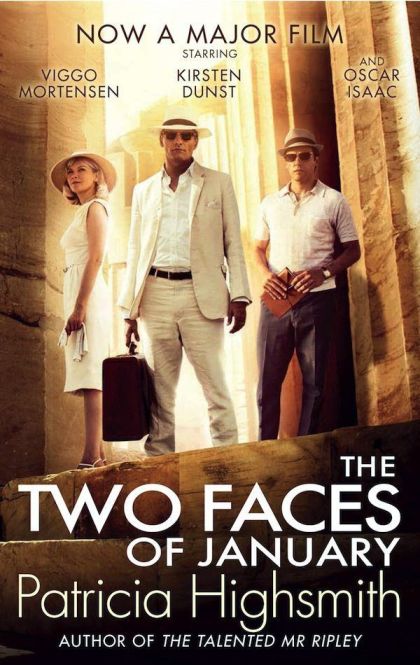
Rydal Keener drifts through 1960s Greece as a small-time con artist, the kind of American who ends up in expatriate circles because staying put anywhere else requires too much of him. Then he sees Chester MacFarland and something breaks open. Chester looks like Rydal's father—the one who died, the one they were never close to. The resemblance is exact enough to feel like an accident of the universe.
Chester kills a man in his hotel room. It happens fast and badly. Rydal doesn't think—he just acts, pulling Chester and his wife Colette into a pact to make the body disappear. Colette is glamorous and untouchable and amused by the chaos. Rydal is obsessed, though he can't quite name what he's obsessed with: Chester himself, or the ghost of his father wearing Chester's face, or something darker that lives in the space between those two things.
The three of them spiral into Crete. The ruins of Knossos become the setting for something that looks like an alliance but feels more like a trap closing around all of them. Rydal wants Chester. Colette wants Rydal. Chester wants out. Paranoia grows in the heat. Jealousy metastasizes. Everyone's watching everyone else, trying to predict who will betray first.
A murder attempt goes wrong. Someone dies—not the person anyone intended. After that, there's no separation between Rydal and Chester anymore. They're bound by what they've done and what's being done to them. They become partners in a game that crosses Europe: blackmail, betrayal, the constant threat of exposure. Their identities become currency. Their lives become collateral.
There's no winning this game. There's only surviving it, or not.
Details
| ISBN | 9780802122629 |
|---|---|
| Copyright Date | 1964 |
| Publication Date | June 17, 1964 |
| Publisher | Crime Club |
| Format | Paperback |
| No. of Pages | 206 |
| Language | English |
| Notes | A lesbian author's entire bibliography matters, even when the work doesn't explicitly name queerness. The argument rests on several overlapping points: The psychological texture these writers bring to female characters and relationships between women carries their perspective whether or not they're writing about explicitly lesbian content. An outsider's way of seeing power dynamics, intimacy, vulnerability—that sensibility bleeds into everything they touch. It's in the subtext, in how relationships are weighted, in what gets attention and what gets ignored. Historically, lesbian writers developed specific techniques to work around censorship and social prohibition. Some shifted focus to male-male relationships as a way to explore forbidden desire, secrecy, transgression—themes that are fundamentally Sapphic even when the characters aren't women. Others used coded language, indirection, psychological density. These strategies shaped their craft across every manuscript. Tracing a complete bibliography reveals evolution. How Patricia Highsmith's 'mainstream' thrillers relate to her explicitly queer work. How consistent themes and obsessions persist across different genre masks. The full picture shows an authorial voice that doesn't splinter—it adapts, conceals, refocuses, but remains coherent. And practically: a database of lesbian literature is about more than content. It's about creators and legacy. Acknowledging the complete body of work means these writers don't get reduced to their 'acceptable' output or erased into respectability. It preserves the full record of how they navigated the work of being both artists and invisible. |
| Genre | Mystery |
| Subject | Fiction / Suspense |