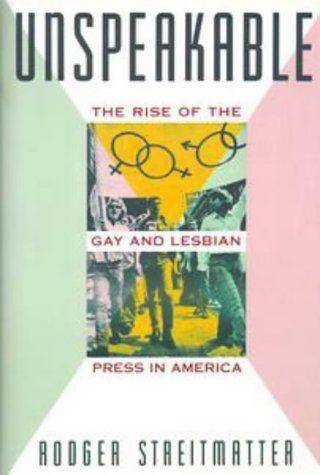
'Unspeakable is a work of history, which is to say it belongs to a discipline that is by its nature profoundly political. Historians make political choices when they choose which facts-whose actions, what relationships, which events-to report and which to leave out. They make deeper choices still when they align those 'facts' in a conceptual grid, such as liberalism, Marxism, or Christianity. When a historian's grid accords closely with the understanding of the world that best serves the interests of those in power, it becomes in- visible, and what is left looks like a simple, factual chronology. Journalism, which is really just history in the present tense, is the same way.
Unfortunately, Streitmatter adopts just enough of the journalist's apparent objectivity to make Unspeakable a fascinating record that is at the same time not very interesting history. In the end he is trapped by his liberalism; although he repudiates the dominant culture's homophobia, without a theory of how homophobia or other forms of oppression originate he has no way to interpret the vast, well-documented record he offers us.
Without, for example, a critique of capitalism, he's disappointed and baffled by the rise in the nineties of slick, 'fluffy' gay periodicals like Out and Deneuve, with their scores of ads from major corporations. He sees the struggle of lesbians and gays as ''one of the most relentless social and political revolutions of the 20th century,' but lacking a political context, the content of his 'revolution' boils down to a list of demands: a cure for AIDS, permission for gays and lesbians to serve in the US military, federal anti-discrimination legislation, and an end to gay-bashing. Most of these are laudable goals.
None of them is revolutionary, in the sense of challenging an underlying system of oppression. So is my complaint that Streitmatter isn't a Marxist or a radical feminist, so he can't be a historian? No, it's more that he isn't really anything that gives him a coherent point of view. By trying to write as if he had no point of view, he ends up reinforcing the status quo, in spite of his passionate commitment to civil rights for lesbians and gay men…' ~ Rebecca Gordon, The Women's Review of Books, Vol. 13, No. 6 (Mar., 1996)
Details
| ISBN | 9780571198733 |
|---|---|
| Copyright Date | 1995 |
| Publication Date | November 1995 |
| Publisher | Faber and Faber |
| Format | Hardcover |
| No. of Pages | 424 |
| Language | English |
| Rating | Not Rated |
| Genre | History |
| Subject | Gay Press - History. - United States; Gay Press Publications - History. - United States |