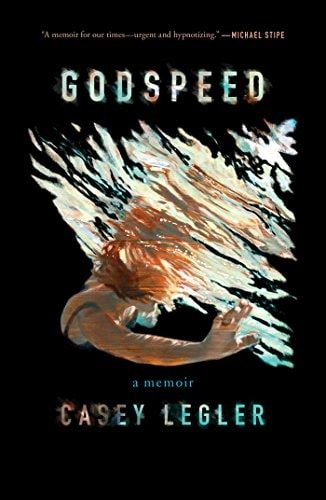
Some memoirs take 500 pages to get out of the author’s childhood. Casey Legler’s Godspeed covers an Olympic career, an addiction, and a teenager’s near-total collapse in 176. The New York Times called it “lean and ferocious,” which is about as accurate a two-word review as you’ll find.
The shortness fits the subject. Legler was one of the fastest swimmers in the world by fifteen. Swimming is a sport measured in hundredths of a second, and her book reads like it was written by someone who learned early that wasted motion costs you.
Here’s the part the sports pages didn’t cover. While she was breaking records, Legler was also an alcoholic, cut off from her family and unable to hold on to anyone. She was sent away from home to train with elite coaches and teams, living in cheap hotels, getting lonelier, sleeping with strangers and using more drugs. At sixteen she competed at the 1996 Atlanta Olympics, where she felt like an outsider among the other athletes and ended up buying drugs for people she barely knew.
It’s a brutal picture of what elite youth sport can look like from the inside. We tend to watch teenage Olympians and see discipline and medals. Legler shows what it’s like to be a kid with an enormous talent, very little support and nowhere to put the pain except the pool and the bottle.
The /books entry describes years of grueling training in France and the United States, and a loneliness she couldn’t see a way out of. What keeps the book from being purely bleak is its ending. Legler eventually finds what the publisher calls a small inner light, a moment of calm in the middle of everything. It isn’t a tidy redemption arc, and the book is better for that.
Readers who know Legler from her later career may come to this with a different picture in mind. She became known as a model and artist, and she was the first woman signed by Ford Models to model menswear. That gender-nonconforming public image is a long way from the girl in the cheap hotel room, which is part of what makes the memoir so striking. You know she got out. The book shows you how close she came to not getting out.
Godspeed was longlisted for the 2019 PEN/ESPN Award for Literary Sports Writing. The bibliography rates it Good, and it files the book under memoir and sports. It also fits comfortably alongside addiction memoirs, and that’s probably the shelf where it does its most important work.
This is for readers who like their memoirs short and sharp. It’s also for anyone who grew up in competitive sport and wondered whether the adults in charge were paying attention, and for readers of recovery stories who are tired of neat endings.
A few questions for the comments. Do short memoirs hit harder than long ones, or do you feel shortchanged? Should there be stronger protections for teenage athletes training far from home? And what was the hardest thing you did at sixteen? (Hopefully not swimming in the Olympics while hungover.)
Full details are on the Godspeed entry in the Lesbian Bibliography.