Translating a novel is hard. Translating poetry is harder. Translating Nicole Brossard might be the hardest of all, because so much of her work happens in the syntax: where a sentence turns, what it leaves out, which word lands on which other word. Move her from French into English and you risk keeping the meaning while losing the poem.
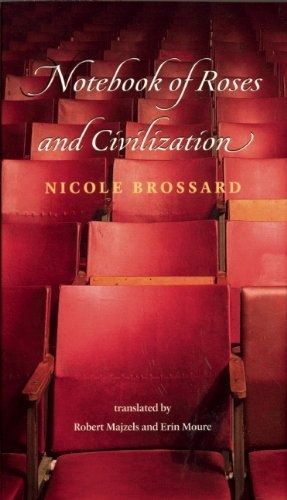
Notebook of Roses and Civilization took that risk with two translators instead of one. Erin Moure and Robert Majzels are both award-winning poets and translators in their own right. The /books entry credits them with carrying Brossard’s distinctive syntax and sensuality into English with skill and sensitivity. Coach House Books, the Toronto press that has published much of Brossard’s work in English, put out the edition in the bibliography.
The poems themselves start with ordinary things. Summer heat on an earlobe. A parking meter. Crabs and pigeons throwing shadows under a cherry tree. An olive. A shoulder blade. These are the kinds of details most of us walk past, and Brossard stops to look at each one. The publisher describes the images moving through the senses toward something beyond language, until together they build a new structure of meaning.
That combination is very Brossard: concrete details, abstract ambition and an undercurrent of desire. She has been called one of the great literary innovators of her generation, especially for the way she writes about desire and gender. In her work, lesbian desire isn’t just a subject. It’s a way of seeing, and it reshapes how she uses language. That’s exactly the kind of thing that’s hard to translate, which is why the choice of translators matters so much here.
Moure is a particularly interesting match. She’s a major Canadian poet herself, known for experimental, multilingual work, and she has translated from French, Spanish, Galician and Portuguese. Majzels is a novelist and translator with a long history of bringing Québécois writing into English. Two translators with two sensibilities, working on one of the most demanding poets in the language, is a fascinating experiment even before you open the book.
If you’ve already read Brossard’s later collection Ardour, also in the bibliography, this makes a good contrast. Ardour is quieter and more inward. Notebook is more about the outside world, the city and the street, and how a body moves through them.
This is for readers who are curious about translation and what gets carried over or lost. It’s also for poets who want to see what close attention to ordinary objects can do, and for readers who already love Brossard and want another angle on her. Bilingual readers might enjoy tracking down the French original and reading the two side by side.
Over to you. Do you read poetry in translation, or does it always feel like something’s missing? Have you ever read the same poem in two different translations and noticed a big difference? And which everyday object do you think deserves a poem of its own? (A parking meter has now been taken.)
Full details are on the Notebook of Roses and Civilization entry in the Lesbian Bibliography.