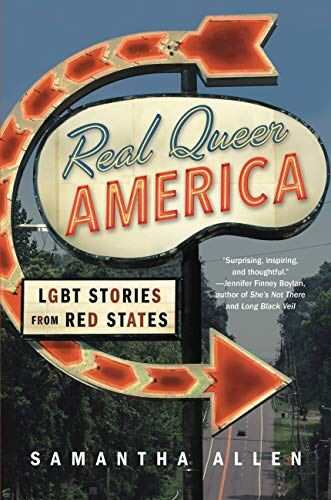
Here’s a question that makes some city-dwelling queers uncomfortable: what if the most interesting LGBT stories in America aren’t happening in New York or San Francisco at all?
Samantha Allen set out to find out. The result is Real Queer America: LGBT Stories from Red States, published by Little, Brown in 2019. Allen, a journalist and a trans woman who was raised Mormon, took a road trip through the parts of the United States that coastal America tends to write off, places with conservative politics and a reputation for being hostile to people like her. What she found was more complicated, and a lot more hopeful, than the stereotype.
The /books entry describes the book as capturing cultural shifts happening in unexpected places. It also describes a national network of chosen family working toward a better world, and calls it “a treasure trove of uplifting stories.” That’s a fair summary of the book’s spirit. Allen meets queer and trans people who have built real communities in towns and small cities, often without much support from anyone.
There’s a reason this matters. For decades, the standard queer story was about leaving. You grew up somewhere small and unwelcoming, you got out, and you found your people in a big city. That story was true for a lot of people. But it left out the ones who stayed, the ones who went back, and the ones who never wanted to leave in the first place. Allen’s book is about them.
The road trip structure works well. Each stop introduces new people and a new local scene, and Allen weaves in her own story along the way: growing up in a religious community, coming out, transitioning. It reads more like a travelogue than a policy book, which makes it easy to pick up and hard to put down.
Canadian readers might find it especially interesting. We tend to look at red-state America from a distance and assume the worst. Allen’s book is a useful reminder that people are living full queer lives in places we’d never think to visit. That doesn’t erase the politics. Allen is clear-eyed about the dangers, especially for trans people. But it does complicate the picture.
The book came out in early 2019, and a lot has changed in American politics since then, particularly for trans people in many of the states she visited. That makes it something of a time capsule. It’s worth reading partly as a record of what people had built, and of what’s now under pressure.
This is for readers who grew up queer in small towns, for anyone planning a road trip and curious about queer life off the beaten path, and for city people who could stand to have their assumptions shaken a little.
In the comments: did you grow up somewhere small, and did you stay, leave or go back? Is the big-city queer story still the default, or has that changed? And which unexpected place has surprised you with its queer community?
Full details are on the Real Queer America entry in the Lesbian Bibliography.