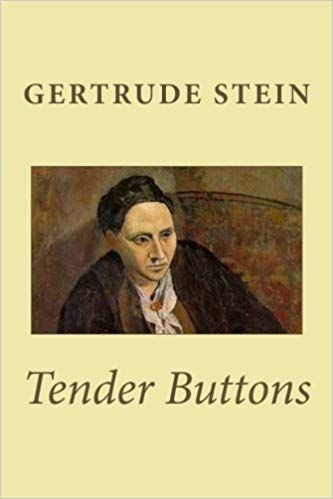
Here’s how Gertrude Stein’s Tender Buttons opens:
“A carafe, that is a blind glass.”
Go ahead and read it again. It doesn’t help. A carafe isn’t a blind glass, and if it is, what does that mean? Stein keeps going like this for the whole book, which first appeared in 1914. She describes objects, food and rooms in sentences that sound like they should make sense and then don’t. Readers have been arguing about it for more than a hundred years.
That’s why it’s still worth picking up. Tender Buttons is less a book you read than a book you play with. The Dover edition listed in the bibliography is only 64 pages, and you could get through it in an afternoon. Understanding it is another matter. Most people never claim to.
The book is divided into three parts: Objects, Food and Rooms. Each is made up of short pieces with titles like “A Box,” “Roastbeef” or “A Petticoat.” The /books entry describes Stein’s writing as closer to painting than to conventional literature, and that’s the key. Stein was living in Paris, collecting and championing painters like Picasso and Matisse. What they were doing with paint, breaking objects into angles and planes, she was trying to do with words. You aren’t meant to see the carafe. You’re meant to see it from several sides at once.
There’s another reading, and it’s the one that makes Tender Buttons interesting for this site. Stein wrote the book while living with Alice B. Toklas, her partner of nearly four decades. Many critics have read it as a coded portrait of their domestic life together: the objects in their apartment, the meals Alice cooked, the rooms they shared. Some read a lot of it as erotic. Even the title is suggestive once you start looking. Stein never spelled any of this out, of course. That was rather the point.
Whether you buy that reading or not, it changes how the book feels. Instead of a cold experiment, it becomes something closer to a private language between two women, written in public where anyone could see it but almost no one could understand it.
Stein’s influence on twentieth-century writing is enormous, and the /books entry credits this book as a big part of that. Poets are still borrowing her tricks. If you’ve ever read a modern poem that repeats a word until it stops meaning anything, or puts ordinary words in an order that makes your brain itch, you’ve met Stein’s descendants.
This is for readers who like a puzzle, poets who want to see where a lot of experimental writing started, and anyone interested in lesbian literary history before anyone used that phrase. It’s also a fun book to read aloud with a friend and a glass of wine. You’ll both be lost, and you’ll both have fun.
For the fuller story of Stein’s Paris circle, Diana Souhami’s No Modernism Without Lesbians has its own entry in the bibliography.
So, the big question for the comments: is Tender Buttons a masterpiece, a joke, or a love letter? Can a book you don’t understand still move you? And what do you think a blind glass is?
Full details are on the Tender Buttons entry in the Lesbian Bibliography.