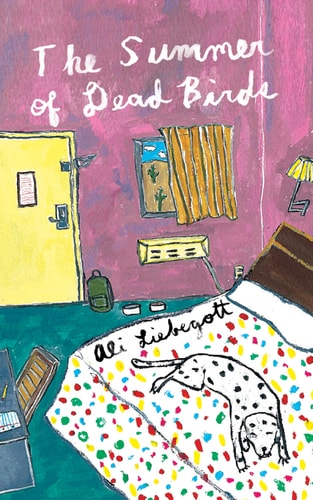
There’s a particular kind of grief that comes with an aging dog. You know the end is coming, you can see it in how slowly they get up in the morning, and you hold on tighter every day. Now add a divorce and the death of someone you love to that, all in the same stretch of time, and you have the summer Ali Liebegott writes about in The Summer of Dead Birds.
The book is an autobiographical novel in verse, published in 2019 by Amethyst Editions, the Feminist Press imprint curated by Michelle Tea. It’s a slim 104 pages. Liebegott is reeling from a painful divorce, grieving a death, and fighting depression. She keeps teaching, keeps walking her aging Dalmatian, Rorschach, and keeps noticing dead birds everywhere she goes. Grief does that. It makes the ordinary world look like it’s full of signs.
At some point she decides to take a road trip, and that section has one of the best titles in recent queer poetry: “Ali and Rorschach at the Center of the World.” A woman and her old dog on the road, trying to outdrive their sadness. It’s funny and heartbreaking at the same time, which is a very Liebegott combination.
If her name is familiar, it might be from her novels, which include The Beautifully Worthless and The IHOP Papers, or from her work as a writer on the TV series Transparent. She has been a fixture of queer literary life for years, and her writing has always had a sharp eye for the absurd and a soft spot for losers, strays and broken things.
The endorsements on the /books entry are strong. O, The Oprah Magazine called it an often-sweet, often-startling novel in verse. Maggie Nelson, author of The Argonauts, called it “a fierce, funny, agonized, cracked-open aria” in homage to fiercely loved things and their passing. That’s the right note. This isn’t a book that wallows. It mourns, it survives, and it manages to be kind to everyone along the way, including the author herself.
The novel in verse is an interesting form for this material. It gives you the emotional compression of poetry, where a single image can hit like a punch, plus the forward motion of a story. You want to know what happens to Ali and Rorschach. You also want to stop and reread a line that caught you off guard.
This is for anyone grieving a pet, a partner or a marriage, and for dog people in general. Fair warning: if your own dog is getting older, keep the tissues handy. It’s also for fans of queer literary fiction who want something short and powerful, and for readers curious about the novel in verse who aren’t sure where to start.
In the comments, let’s talk about this. Did a pet ever get you through a terrible stretch? Do you notice “signs” when you’re grieving, like Liebegott’s dead birds? And what’s the best road trip you’ve ever taken to get away from something?
Publication details are on The Summer of Dead Birds entry in the Lesbian Bibliography.