Black Interest

Minority Stress And Lesbian Women by Virginia R. Brooks
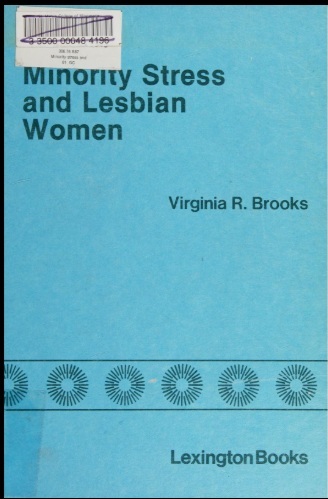
**Part I: Redefining the Problem**
**Introduction**
– Overview
– Terms and Definitions
**The Etiological Question**
– The Biological Argument
– Methodological Considerations
– The Psychoanalytic Argument
– The Socialization Argument
– The Sociocultural Response
**Sex Roles, Androgyny, and Mental Health**
– Concepts and Linkages
– Sex-Role Conformity versus Nonconformity: Comparative Outcomes
– Androgyny and Lesbian Women
**Stratification and Exclusion**
– Minority Status of Women
– Rationale for Minority Exclusion
– Social and Economic Exclusion of Lesbian Women
**Part II: Minority Stress: Theoretical and Empirical Model**
**The Theory of Minority Stress**
– Overview of Stress Theory
– Minority Status as Stressor
– Minority Stress and Problems in Measurement
**Stress-Response Variables among Lesbian Women**
– Stress Indexes
– Hypotheses
– Factors Associated with Negative and Positive Outcomes
– Need for Further Research
**Coping Resources**
– Defining Coping
– Stress-Mediating Resources
– Individual Responses and Minority-Group Patterns
– Model for Analysis of Minority-Stress Variables
**Part III: Redefining Self, Group, and Social Context**
**Identity Conflicts, Cognitive Dissonance, and Resolution**
– Faulty Premises and Self-Concept
– ‘Personal’ Identity versus ‘Lesbian’ Identity
– Reassessing Social Reality
**Intragroup Differences**
– Group Identity and Class Differences
– Upward and Downward Mobility
– Collective Diversity
**Social Disclosure**
– Stress of Disclosure versus Nondisclosure
– Variables in Disclosure Decisions
– Disclosure: The Personal Becomes Political
This Bridge Called My Back by Cherr e Moraga; Gloria Anzald a
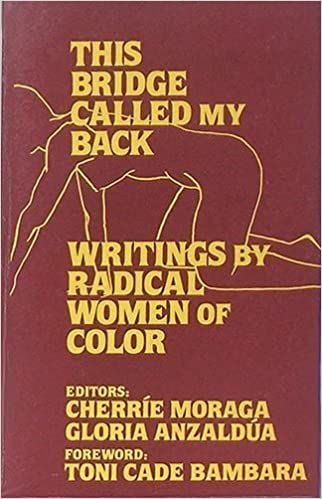
classic collection of feminist writings
This Bridge Called My Back Writings By Radical Women Of Color by Theresa A. Jones
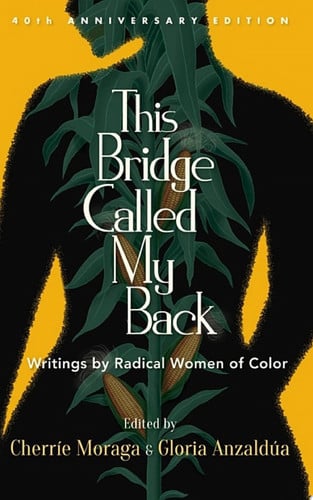
Fortieth anniversary edition of the foundational text of women of color feminism.Originally released in 1981, This Bridge Called My Back is a testimony to women of color feminism as it emerged in the last quarter of the twentieth century. Through personal essays, criticism, interviews, testimonials, poetry, and visual art, the collection explores, as coeditor Cherr e Moraga writes, ‘the complex confluence of identities-race, class, gender, and sexuality-systemic to women of color oppression and liberation.’Reissued here, forty years after its inception, this anniversary edition contains a new preface by Moraga reflecting on Bridge’s ‘living legacy’ and the broader community of women of color activists, writers, and artists whose enduring contributions dovetail with its radical vision. Further features help set the volume’s historical context, including an extended introduction by Moraga from the 2015 edition, a statement written by Gloria Anzald a in 1983, and visual art produced during the same period by Betye Saar, Ana Mendieta, Yolanda L pez, and others, curated by their contemporary, artist Celia Herrera Rodr guez. Bridge continues to reflect an evolving definition of feminism, one that can effectively adapt to and help inform an understanding of the changing economic and social conditions of women of color in the United States and throughout the world.
This Bridge Called My Back, Fourth Edition Writings By Radical Women Of Color by Cherri?e Moraga
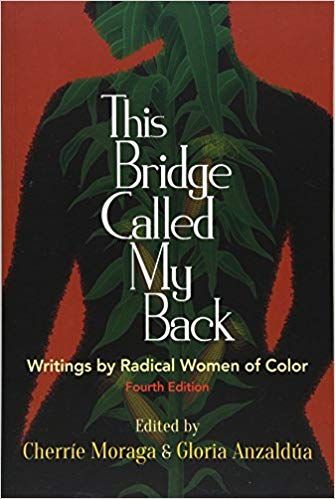
Updated and expanded edition of the foundational text of women of color feminism.Originally released in 1981, This Bridge Called My Back is a testimony to women of color feminism as it emerged in the last quarter of the twentieth century. Through personal essays, criticism, interviews, testimonials, poetry, and visual art, the collection explores, as coeditor Cherr e Moraga writes, the complex confluence of identities race, class, gender, and sexuality systemic to women of color oppression and liberation. Reissued here, nearly thirty-five years after its inception, the fourth edition contains an extensive new introduction by Moraga, along with a previously unpublished statement by Gloria Anzald a. The new edition also includes visual artists whose work was produced during the same period as Bridge, including Betye Saar, Ana Mendieta, and Yolanda L pez, as well as current contributor biographies. Bridge continues to reflect an evolving definition of feminism, one that can effectively adapt to, and help inform an understanding of the changing economic and social conditions of women of color in the United States and throughout the world. Immense is my admiration for the ongoing dialogue and discourse on feminism, Indigenous feminism, the defining discussions in women of color movements and the broader movement. I have loved this book for thirty years, and am so pleased we have returned with our stories, words, and attributes to the growing and resilient movement. Winona LaDuke (Anishinaabe), Executive Director, Honor the EarthPraise for the Third Edition This Bridge Called My Back dispels all doubt about the power of a single text to radically transform the terrain of our theory and practice. Twenty years after its publication, we can now see how it helped to untether the production of knowledge from its disciplinary anchors and not only in the field of women s studies. This Bridge has allowed us to define the promise of research on race, gender, class and sexuality as profoundly linked to collaboration and coalition-building. And perhaps most important, it has offered us strategies for transformative political practice that are as valid today as they were two decades ago. Angela Davis, University of California, Santa Cruz This Bridge Called My Back has served as a significant rallying call for women of color for a generation, and this new edition keeps that call alive at a time when divisions prove ever more stubborn and dangerous. A much-cited text, its influence has been visible and broad both in academia and among activists. We owe much of the sound of our present voices to the brave scholars and feminists whose ideas and ideals crowd its pages. Shirley Geok-lin Lim, University of California, Santa Barbara This book is a manifesto the 1981 declaration of a new politics US Third World Feminism. No great de-colonial writer, from Fanon, Shaarawi, Blackhawk, or Sartre, to Mountain Wolf Woman, de Beauvoir, Saussure, or Newton could have alone proclaimed this politic born of necessity. This politic denies no truths: its luminosities drive into and through our bodies. Writers and readers alike become shape-shifters, are invited to enter the shaman/witness state, to invoke power differently. US Third World Feminism requires a re-peopling: the creation of planetary citizen-warriors. This book is a guide that directs citizenry shadowed in hate, terror, suffering, disconnection, and pain toward the light of social justice, gender and erotic liberation, peace, and revolutionary love. This Bridge transits our dreams, and brings them to the real. Chela Sandoval, University of California, Santa Barbara
A Love Letter To This Bridge Called My Back by Gloria J. Wilson

In 1981, Chicana feminist intellectuals Cherr e Moraga and Gloria Anzald a published what would become a touchstone work for generations of feminist women of color the seminal This Bridge Called My Back: Writings by Radical Women of Color. To celebrate and honor this important work, editors gloria j. wilson, Joni B. Acuff, and Amelia M. Kraehe offer new generations A Love Letter to This Bridge Called My Back. In A Love Letter, creators illuminate, question, and respond to current politics, progressive struggles, transformations, acts of resistance, and solidarity, while also offering readers a space for renewal and healing. The central theme of the original Bridge is honored, exposing the lived realities of women of color at the intersections of race, class, gender, ethnicity, and sexuality, advancing those early conversations on what it means to be Third World feminist conscious. A Love Letter recognizes the challenges faced by women of color in a twenty-first-century world of climate and economic crises, increasing gun violence, and ever-changing social media constructs for women of color. It also retains the clarion call Bridge set in motion, as Moraga wrote: A theory in the flesh means one where the physical realities of our lives our skin color, the land or concrete we grew up on, our sexual longing all fuse to create a politic born of necessity.