Minority Stress And Lesbian Women by Virginia R. Brooks

**Part I: Redefining the Problem**nn**Introduction**n- Overviewn- Terms and Definitionsnn**The Etiological Question**n- The Biological Argumentn- Methodological Considerationsn- The Psychoanalytic Argumentn- The Socialization Argumentn- The Sociocultural Responsenn**Sex Roles, Androgyny, and Mental Health**n- Concepts and Linkagesn- Sex-Role Conformity versus Nonconformity: Comparative Outcomesn- Androgyny and Lesbian Womennn**Stratification and Exclusion**n- Minority Status of Womenn- Rationale for Minority Exclusionn- Social and Economic Exclusion of Lesbian Womennn**Part II: Minority Stress: Theoretical and Empirical Model**nn**The Theory of Minority Stress**n- Overview of Stress Theoryn- Minority Status as Stressorn- Minority Stress and Problems in Measurementnn**Stress-Response Variables among Lesbian Women**n- Stress Indexesn- Hypothesesn- Factors Associated with Negative and Positive Outcomesn- Need for Further Researchnn**Coping Resources**n- Defining Copingn- Stress-Mediating Resourcesn- Individual Responses and Minority-Group Patternsn- Model for Analysis of Minority-Stress Variablesnn**Part III: Redefining Self, Group, and Social Context**nn**Identity Conflicts, Cognitive Dissonance, and Resolution**n- Faulty Premises and Self-Conceptn- ‘Personal’ Identity versus ‘Lesbian’ Identityn- Reassessing Social Realitynn**Intragroup Differences**n- Group Identity and Class Differencesn- Upward and Downward Mobilityn- Collective Diversitynn**Social Disclosure**n- Stress of Disclosure versus Nondisclosuren- Variables in Disclosure Decisionsn- Disclosure: The Personal Becomes Political

Trauma, Stress, And Resilience Among Sexual Minority Women Rising Like The Phoenix by Kimberly F. Balsam

Prevent victimization of sexual minority women by raising your awareness level! Trauma, Stress, and Resilience Among Sexual Minority Women: Rising Like the Phoenix is the first resource to examine trauma, violence, and stress as experienced by lesbian and bisexual women. You’ll gain a better understanding of the stressors that these women experience, including the cultural/social trauma of living with homophobia and heterosexism as well as the individual traumas of verbal, physical, and sexual abuse. This book contains never-before-seen data that investigates the prevalence, impact, and meaning of traumatic experiences in the lives of sexual minority women. In Trauma, Stress, and Resilience Among Sexual Minority Women, top researchers use direct quotes and case examples to illustrate and personalize the emotional strain these women endure. Furthermore, they address constructive individual and community responses that promote resilience and healing. The information and strategies contained in this book will help sexual minority women, as well as the practitioners who serve them, understand and heal from the impact of individual and cultural trauma. This book will increase your knowledge of: developmental issues facing lesbian and bisexual youths the impact of sexual abuse history on the coming out process ethnic/racial differences in trauma among lesbian and bisexual women the prevalence and impact of traumatic experience among HIV+ lesbian and bisexual women the unique stressors facing African-American lesbiansand how they cope organized religion’s approaches to homosexuality and how this impacts lesbian and bisexual women Trauma, Stress, and Resilience Among Sexual Minority Women also shows how data on same-sex domestic violence and hate crimes can be gathered and used as a tool for social and political advocacy, bringing about positive changes that can improve the lives of many lesbian and bisexual women. This book is insightful reading for mental health, health, and social service professionals working with lesbian and bisexual clients or patients, and activists and individuals who work for organizations that serve the gay/lesbian/bisexual/transgender communities.

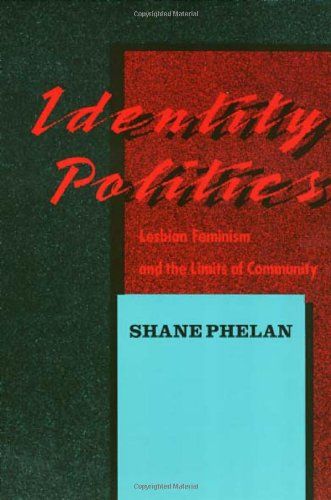
Identity Politics Lesbian Feminism And The Limits Of Community by Shane Phelan

‘Lesbian feminism began and has fueled itself with the rejection of liberalism…. In this rejection, lesbian feminists were not alone. They were joined by the New Left, by many blacks in the civil rights movement, by male academic theorists…. What all these groups shared was an intense awareness of the ways in which liberalism fails to account for the social reality of the world, through a reliance upon law and legal structure to define membership, through individualism, through its basis in a particular conception of rationality.’ In tracing how lesbian feminism came to be defined in uneasy relationships with the Women’s Movement and gay rights groups, Shane Phelan explores the tension between liberal ideals of individual rights and tolerance and communitarian ideals of solidarity. The debate over lesbian sado-masochism—an expression of individual choice or pornographic, anti-feminist behavior?—is considered as a test case. Phelan addresses the problems faced by ‘the woman-identified woman’ in a liberal society that presumes heterosexuality as the biological, psychological, and moral standard. Often silenced by laws defining their sexual behavior as criminal and censured by a medical establishment that persists in defining homosexuality as perversion, lesbians, like blacks and other groups, have fought to have the same rights as others in their communities and even in their own homes. Lesbian feminists have also sought to define themselves as a community that would be distinctly different, a community that would disavow the traditional American obsession with individual advancement in the world as it is. In this controversial study of political philosophy and the women’s movement, Phelan argues that ‘the failure to date to produce a satisfying theory and program for lesbian action is reflective of the failure of modern political thinking to produce a compelling, nonsuspect alternative to liberalism.’ In the series Women in the Political Economy, edited by Ronnie J. Steinberg.

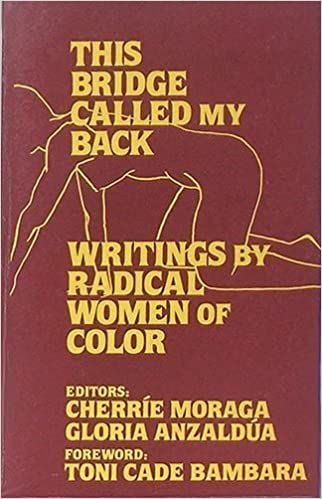
This Bridge Called My Back, Fourth Edition Writings By Radical Women Of Color by Cherríe Moraga

Updated and expanded edition of the foundational text of women of color feminism.Originally released in 1981, This Bridge Called My Back is a testimony to women of color feminism as it emerged in the last quarter of the twentieth century. Through personal essays, criticism, interviews, testimonials, poetry, and visual art, the collection explores, as coeditor Cherríe Moraga writes, “the complex confluence of identities—race, class, gender, and sexuality—systemic to women of color oppression and liberation.”Reissued here, nearly thirty-five years after its inception, the fourth edition contains an extensive new introduction by Moraga, along with a previously unpublished statement by Gloria Anzaldúa. The new edition also includes visual artists whose work was produced during the same period as Bridge, including Betye Saar, Ana Mendieta, and Yolanda López, as well as current contributor biographies. Bridge continues to reflect an evolving definition of feminism, one that can effectively adapt to, and help inform an understanding of the changing economic and social conditions of women of color in the United States and throughout the world.“Immense is my admiration for the ongoing dialogue and discourse on feminism, Indigenous feminism, the defining discussions in women of color movements and the broader movement. I have loved this book for thirty years, and am so pleased we have returned with our stories, words, and attributes to the growing and resilient movement.” — Winona LaDuke (Anishinaabe), Executive Director, Honor the EarthPraise for the Third Edition“This Bridge Called My Back … dispels all doubt about the power of a single text to radically transform the terrain of our theory and practice. Twenty years after its publication, we can now see how it helped to untether the production of knowledge from its disciplinary anchors—and not only in the field of women’s studies. This Bridge has allowed us to define the promise of research on race, gender, class and sexuality as profoundly linked to collaboration and coalition-building. And perhaps most important, it has offered us strategies for transformative political practice that are as valid today as they were two decades ago.” — Angela Davis, University of California, Santa Cruz“This Bridge Called My Back … has served as a significant rallying call for women of color for a generation, and this new edition keeps that call alive at a time when divisions prove ever more stubborn and dangerous. A much-cited text, its influence has been visible and broad both in academia and among activists. We owe much of the sound of our present voices to the brave scholars and feminists whose ideas and ideals crowd its pages.” — Shirley Geok-lin Lim, University of California, Santa Barbara“This book is a manifesto—the 1981 declaration of a new politics ‘US Third World Feminism.’ No great de-colonial writer, from Fanon, Shaarawi, Blackhawk, or Sartre, to Mountain Wolf Woman, de Beauvoir, Saussure, or Newton could have alone proclaimed this ‘politic born of necessity.’ This politic denies no truths: its luminosities drive into and through our bodies. Writers and readers alike become shape-shifters, are invited to enter the shaman/witness state, to invoke power differently. ‘US Third World Feminism’ requires a re-peopling: the creation of planetary citizen-warriors. This book is a guide that directs citizenry shadowed in hate, terror, suffering, disconnection, and pain toward the light of social justice, gender and erotic liberation, peace, and revolutionary love. This Bridge … transits our dreams, and brings them to the real.” — Chela Sandoval, University of California, Santa Barbara

This Bridge Called My Back Writings By Radical Women Of Color by Theresa A. Jones

Fortieth anniversary edition of the foundational text of women of color feminism.Originally released in 1981, This Bridge Called My Back is a testimony to women of color feminism as it emerged in the last quarter of the twentieth century. Through personal essays, criticism, interviews, testimonials, poetry, and visual art, the collection explores, as coeditor Cherríe Moraga writes, ‘the complex confluence of identities-race, class, gender, and sexuality-systemic to women of color oppression and liberation.’Reissued here, forty years after its inception, this anniversary edition contains a new preface by Moraga reflecting on Bridge’s ‘living legacy’ and the broader community of women of color activists, writers, and artists whose enduring contributions dovetail with its radical vision. Further features help set the volume’s historical context, including an extended introduction by Moraga from the 2015 edition, a statement written by Gloria Anzaldúa in 1983, and visual art produced during the same period by Betye Saar, Ana Mendieta, Yolanda López, and others, curated by their contemporary, artist Celia Herrera Rodríguez. Bridge continues to reflect an evolving definition of feminism, one that can effectively adapt to and help inform an understanding of the changing economic and social conditions of women of color in the United States and throughout the world.