Winner of the 1971 American Library Assoc.’s first Gay Book Award, later called Stonewall Book Award
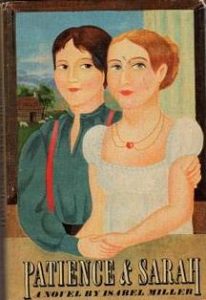
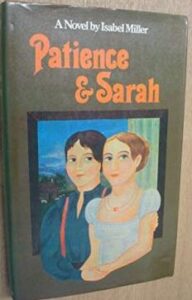
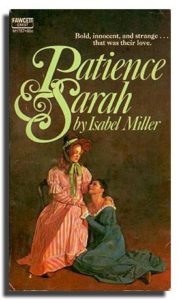
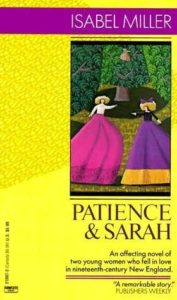
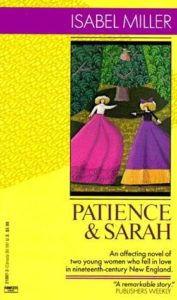
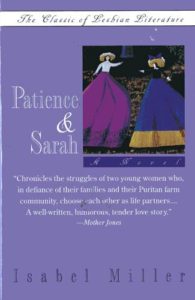
Set in the nineteenth century, Isabel Miller‘s classic lesbian novel traces the relationship between Patience White, an educated painter, and Sarah Dowling, a farmer, whose romantic bond does not sit well with the puritanical New England farming community in which they live. Ultimately, they are forced to make life-changing decisions that depend on their courage and their commitment to one another.
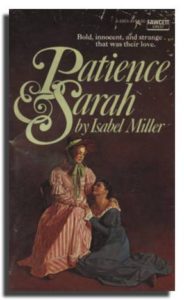
First self-published in 1969 in an edition of 1,000 copies, it garnered increasing attention to the point of receiving the American Library Association’s first Gay Book Award. Patience & Sarah is a historical romance that was a touchstone for the burgeoning gay and women’s activism of the late 1960s and early 1970; it celebrates the joys of an uninhibited love between two strong women with a confident defiance that remains relevant today.
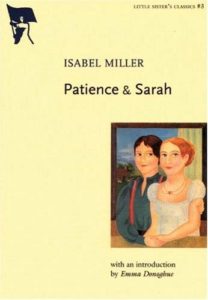
This edition features an appendix of supplementary materials, as well as an introduction by Emma Donoghue, whose numerous books include Stirfry, Hood, and Life Mask, which was shortlisted for a 2005 Lambda Literary Award and the Ferro-Grumley Award.
Few novels carry as much history for lesbian readers. Alma Routsong, writing as Isabel Miller (Isabel is an anagram of Lesbia, and Miller was her mother's maiden name), drew the story from the life of the early nineteenth-century New England painter Mary Ann Willson. When no publisher would take the book, she published it herself in 1969 as A Place for Us, in an edition of one thousand copies, and sold it by hand, including outside meetings of the New York chapter of the Daughters of Bilitis.
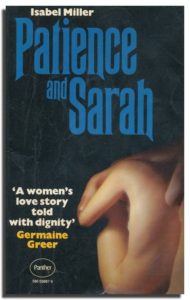
In 1971 the American Library Association's Task Force on Gay Liberation chose it for the first Gay Book Award, the prize now known as the Stonewall Book Award. McGraw-Hill then published it as Patience and Sarah and brought it into bookstores across the country, and it has been reprinted many times since, including an Arsenal Pulp Press edition with an introduction by Emma Donoghue. Library Journal has called it one of the first lesbian novels with a happy ending, and the Publishing Triangle placed it at number 24 on its 1999 list of the 100 best lesbian and gay novels.
The story has also moved beyond the page. Composer Paula M. Kimper and librettist Wende Persons adapted it as an opera that premiered at the Lincoln Center Festival on July 8, 1998, and it is widely described as the first lesbian opera. More than half a century after Routsong sold her first copies by hand, Patience and Sarah remains a cornerstone of lesbian historical fiction.




Comment
Few novels carry as much history for lesbian readers. Alma Routsong, writing as Isabel Miller (Isabel is an anagram of Lesbia, and Miller was her mother's maiden name), drew the story from the life of the early nineteenth-century New England painter Mary Ann Willson. When no publisher would take the book, she published it herself in 1969 as A Place for Us, in an edition of one thousand copies, and sold it by hand, including outside meetings of the New York chapter of the Daughters of Bilitis.
In 1971 the American Library Association's Task Force on Gay Liberation chose it for the first Gay Book Award, the prize now known as the Stonewall Book Award. McGraw-Hill then published it as Patience and Sarah and brought it into bookstores across the country, and it has been reprinted many times since, including an Arsenal Pulp Press edition with an introduction by Emma Donoghue. Library Journal has called it one of the first lesbian novels with a happy ending, and the Publishing Triangle placed it at number 24 on its 1999 list of the 100 best lesbian and gay novels.
The story has also moved beyond the page. Composer Paula M. Kimper and librettist Wende Persons adapted it as an opera that premiered at the Lincoln Center Festival on July 8, 1998, and it is widely described as the first lesbian opera. More than half a century after Routsong sold her first copies by hand, Patience and Sarah remains a cornerstone of lesbian historical fiction.